MA 240 Discrete Mathematics NAME: ________________________________
Fall 2005 Instructor: Jeffrey Horn
QUIZ 3: Demolition of
the Sears Tower by Digital
Braitenberg Vehicles
| Handed out/Assigned: | Monday, November 7, 2005 |
BACKGROUND:
Believe it or not, we have been approached to CONSIDER (at least) the idea of using our robot(s) to bring down the Jenga block Sears Tower that our very own Bryant Varney, Jenga Architect Extraordinaire, has built in the atrium of the Student Services Building (a.k.a., Hedgcock Fieldhouse). As academics, we will take this proposal seriously, and consider a discrete approach!
Here is Bryant's web site on his Jenga creations: http://faculty.nmu.edu/ims/jenga.htm Specifically, here are the Sears Tower photos: http://faculty.nmu.edu/ims/sears.htm and http://faculty.nmu.edu/ims/sears1.htm and here is video of the last creation, Tower at Pisa, coming down: http://faculty.nmu.edu/ims/jenga_crash.mov. What do you think? Can it be done? Should it be done?
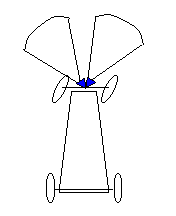
Let's use a digital Braitenberg Vehicle, as in HW3, but with Ackerman steering (car steering) rather than the "dual differential drive" of hw3. Still have left and right binary obstacle detectors, but for output, we have
OUTPUT: Two bits: "00" means stop, "01" means forward to the right, "10" means forward to the left", and "11" means straight ahead full!
If you think you need or want a "memory bit", go ahead and add one! Please be clear that that is what the extra output and input are for...
TASK 1: So your task is to come up with a car, including sensor configuration and associated truth table (but no circuits; we will program the truth table directly into the microprocessor), that will bring down the Sears Tower by "sideswiping" it, preferably by hitting a corner. You can assume that the starting position of the vehicle will be with the tower in front of it, directly ahead but far enough away to be outside the range of any of the sensors (obstacle detectors). Turn in your design, on paper or electronically, I don't care!
I hope we can test it for real, if not on the actual Sears Tower then on a smaller "mock up" (anyone have any Jengas? :-).
TASK 2: Combinatorics! (combined with logic!) Count up for me, the total number of possible "strategies" that your robot design has (that is, settings of output bits of your truth table; this is exp(2,X), where X is the number of output bits). DON'T FORGET THIS SECOND TASK!!!!