Joseph Priestley and the Discovery of Oxygen
A Kuhnian Case Study (Structure, Ch. 6-8)
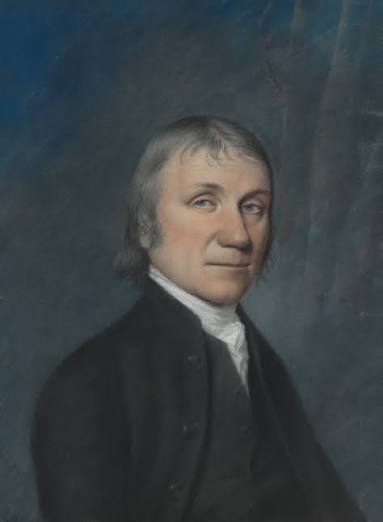
Joseph Priestley (1733–1804)
Dissenting minister and natural philosopher; isolated “dephlogisticated air” (oxygen) on Aug 1, 1774; interpreted his own results within the phlogiston paradigm — a Ch. 6 example of discovery as an extended process, not a single “eureka” event.
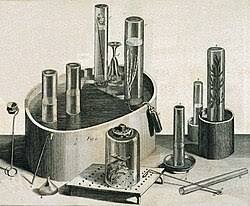
Priestley’s Pneumatic Apparatus
The pneumatic trough and gas-collecting jars Priestley used to isolate and study “airs.” Instrumentation like this is part of what Kuhn means by a paradigm’s shared tools, not just its theories.
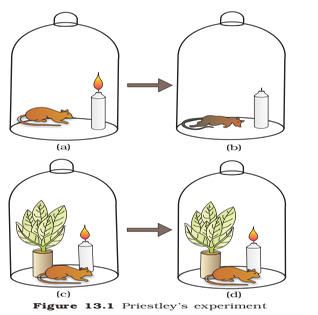
The Mouse-and-Candle Experiment
(a)-(b) a candle and mouse “use up” the air in a sealed jar; (c)-(d) a sprig of mint/plant restores the air’s capacity to support flame and life. The anomaly here — air that supports combustion/respiration can be “restored” — is exactly the kind of paradigm-violating result Ch. 6 says discovery begins with.
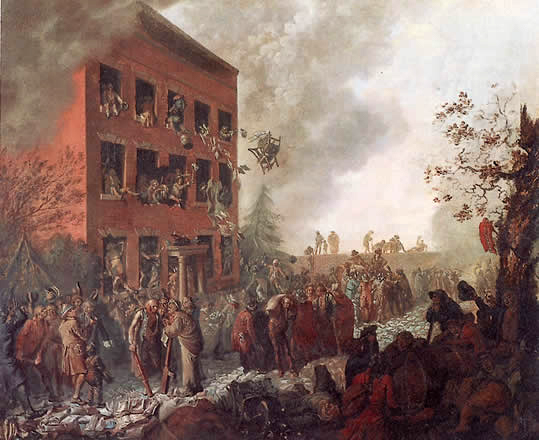
The Birmingham (“Priestley”) Riots, 1791
A mob burned Priestley’s house, laboratory, and papers in July 1791 over his support for the French Revolution and religious dissent — a reminder that the reception of new science (and new ideas generally) is a social and political process, not just an intellectual one. Useful bridge into Ch. 7-8’s discussion of resistance to paradigm change.
Antoine Lavoisier (1743–1794)
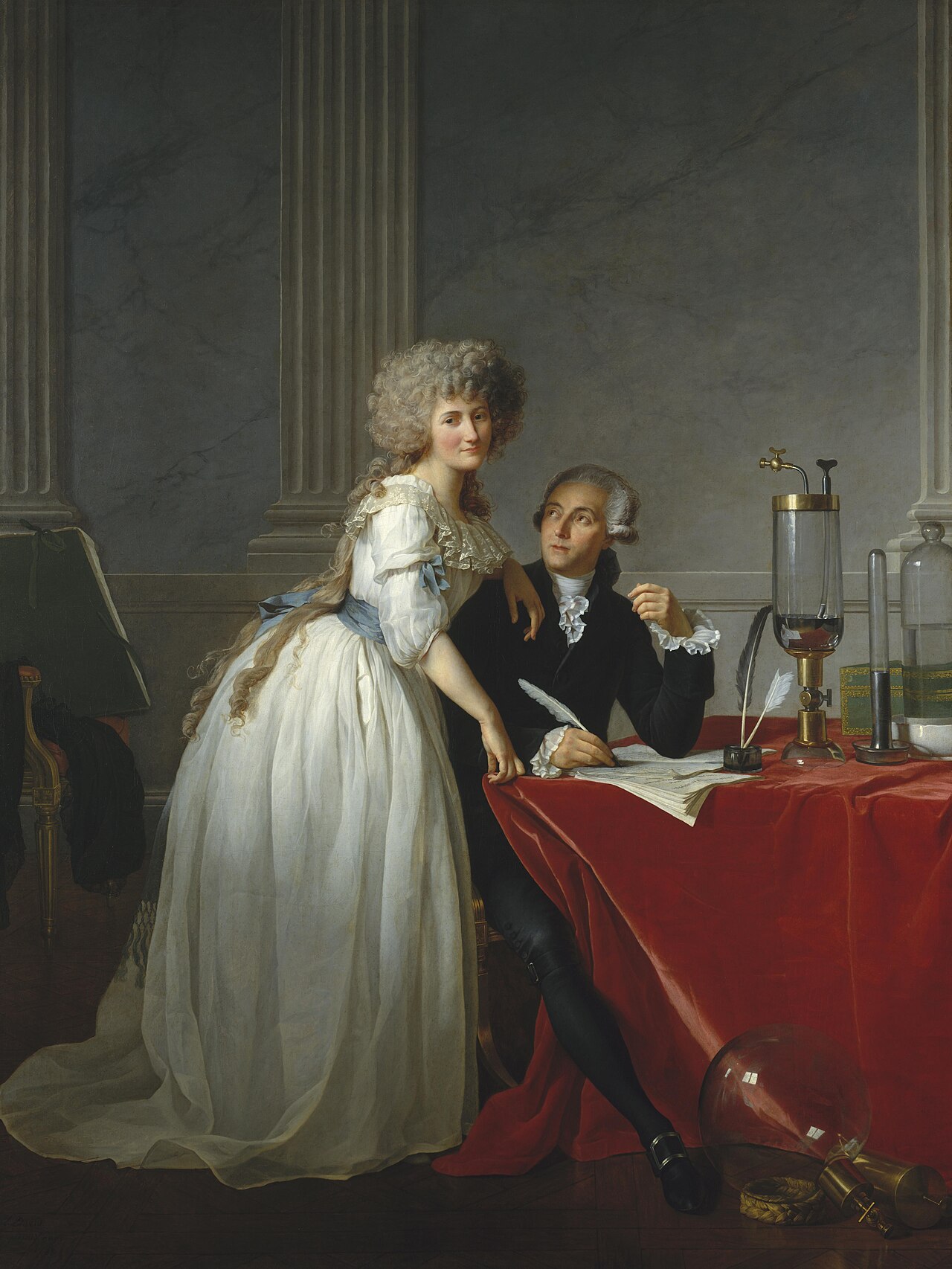
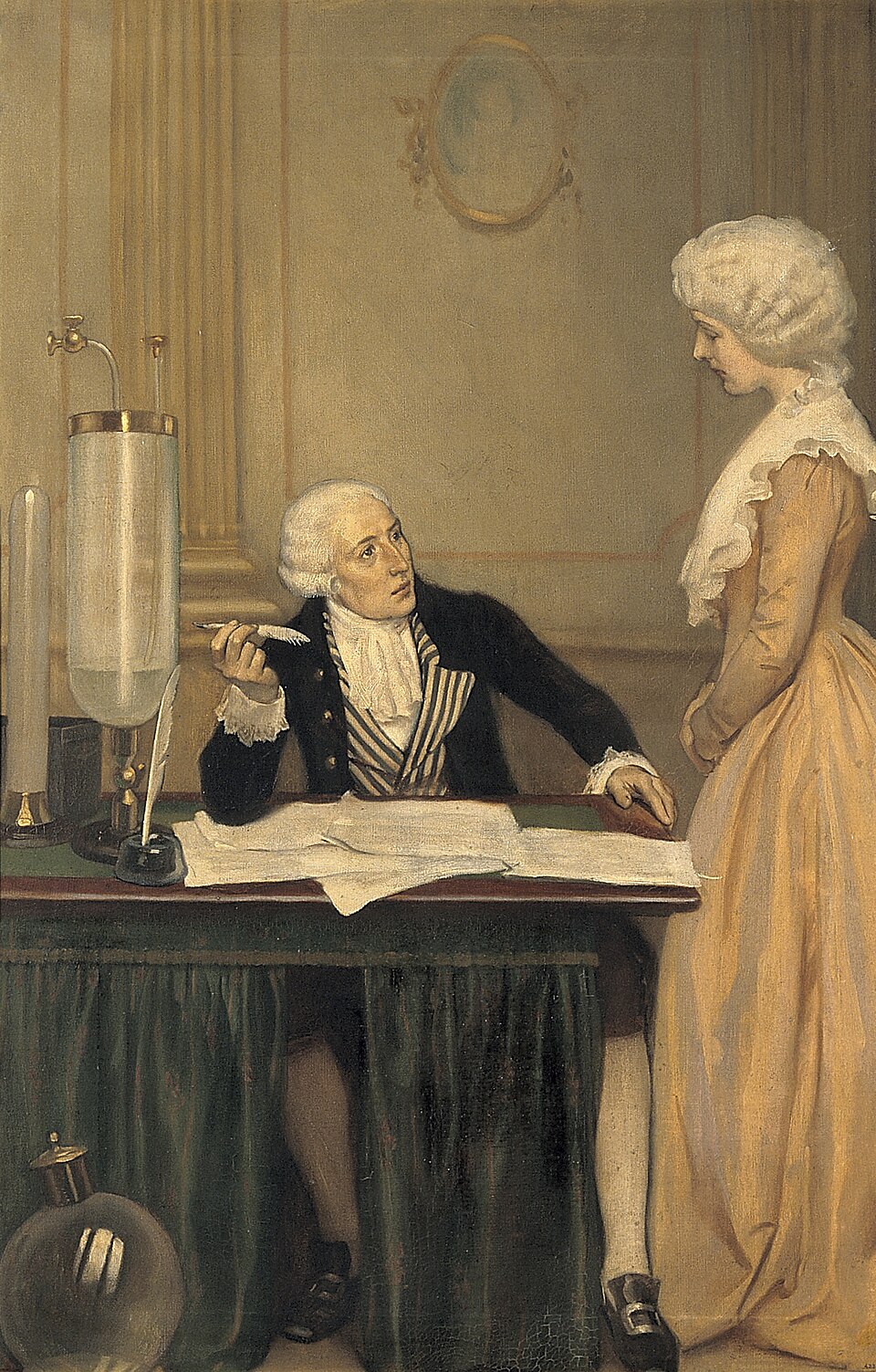
Antoine-Laurent Lavoisier and His Wife , Jacques-Louis David, 1788.
Born August 26, 1743 in Paris to a wealthy family; he inherited a fortune at age five and, though trained in law, was drawn instead to chemistry, botany, astronomy, and mathematics at the Collège des Quatre-Nations. At 26 he bought into the Ferme Générale, the widely hated royal tax-farming syndicate — a position that funded his private laboratory and made him one of the best-equipped scientists in Europe, but that would also mark him as a target once the Revolution turned on the old regime’s financial class. Historians credit him with turning chemistry “from a qualitative to a quantitative science,” largely on the strength of the precise, weighed experiments in the slides that follow.
Disproving Phlogiston: The Composition of Air
Starting in late 1772, Lavoisier ran a series of carefully weighed combustion experiments — burning phosphorus, calcining tin and lead in sealed vessels — showing that metals gained weight by combining with air rather than by losing phlogiston. After meeting Joseph Priestley in October 1774 and learning of “dephlogisticated air,” Lavoisier reinterpreted the same gas as a distinct element, naming it “oxygen” (Greek for “acid-former”) in 1778. His 1783 pamphlet Réflexions sur le phlogistique directly attacked the century-old phlogiston paradigm, and by 1789 his Traité élémentaire de chimie — often called the first modern chemistry textbook — laid out the oxygen theory, the law of conservation of mass (“nothing is lost, nothing is created, everything is transformed”), and a system of chemical nomenclature still recognizable today.
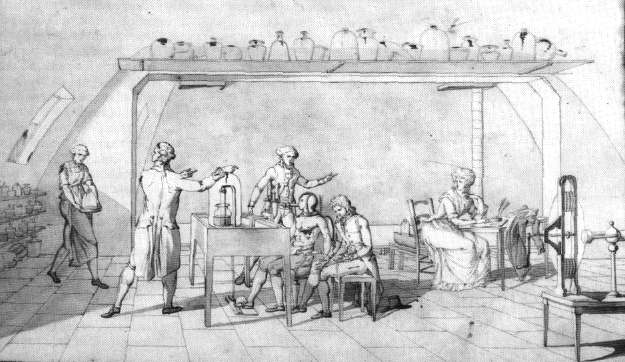
Human Respiration Experiments
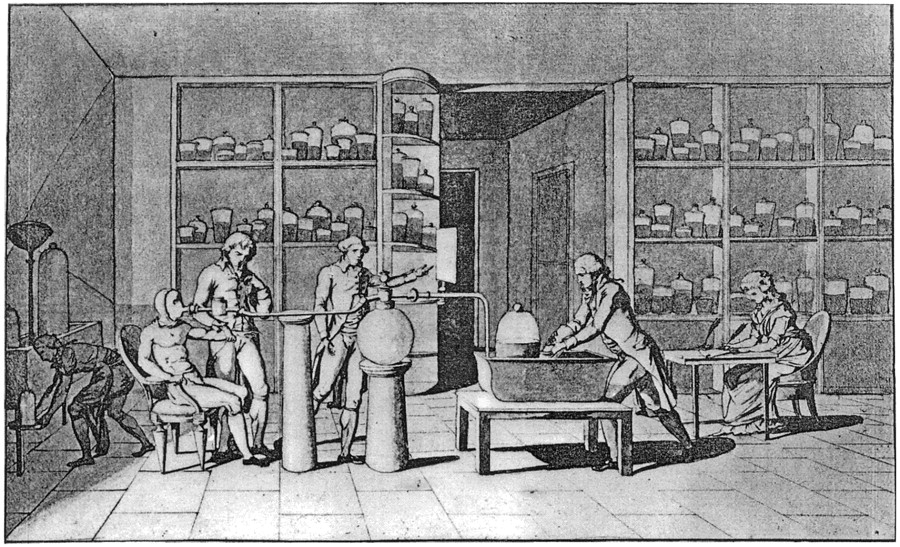
Lavoisier’s most significant respiration research was carried out over the winter of 1782–83 with Pierre-Simon Laplace, and continued in 1789–90 with Armand Seguin, fitting human subjects with breathing apparatus to measure oxygen consumed and carbon dioxide produced. Comparing the heat and CO2 given off by a resting person to the heat from burning enough charcoal to produce the same amount of CO2, Lavoisier concluded that “respiration is therefore a combustion” — a slow, internal burning that maintains body heat. The work was cut short by the Revolution but effectively founded the modern science of metabolism.
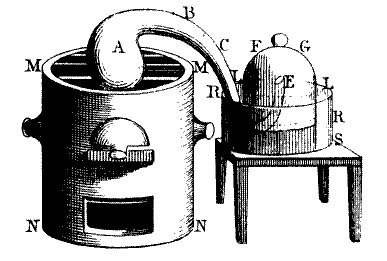
The Ice Calorimeter
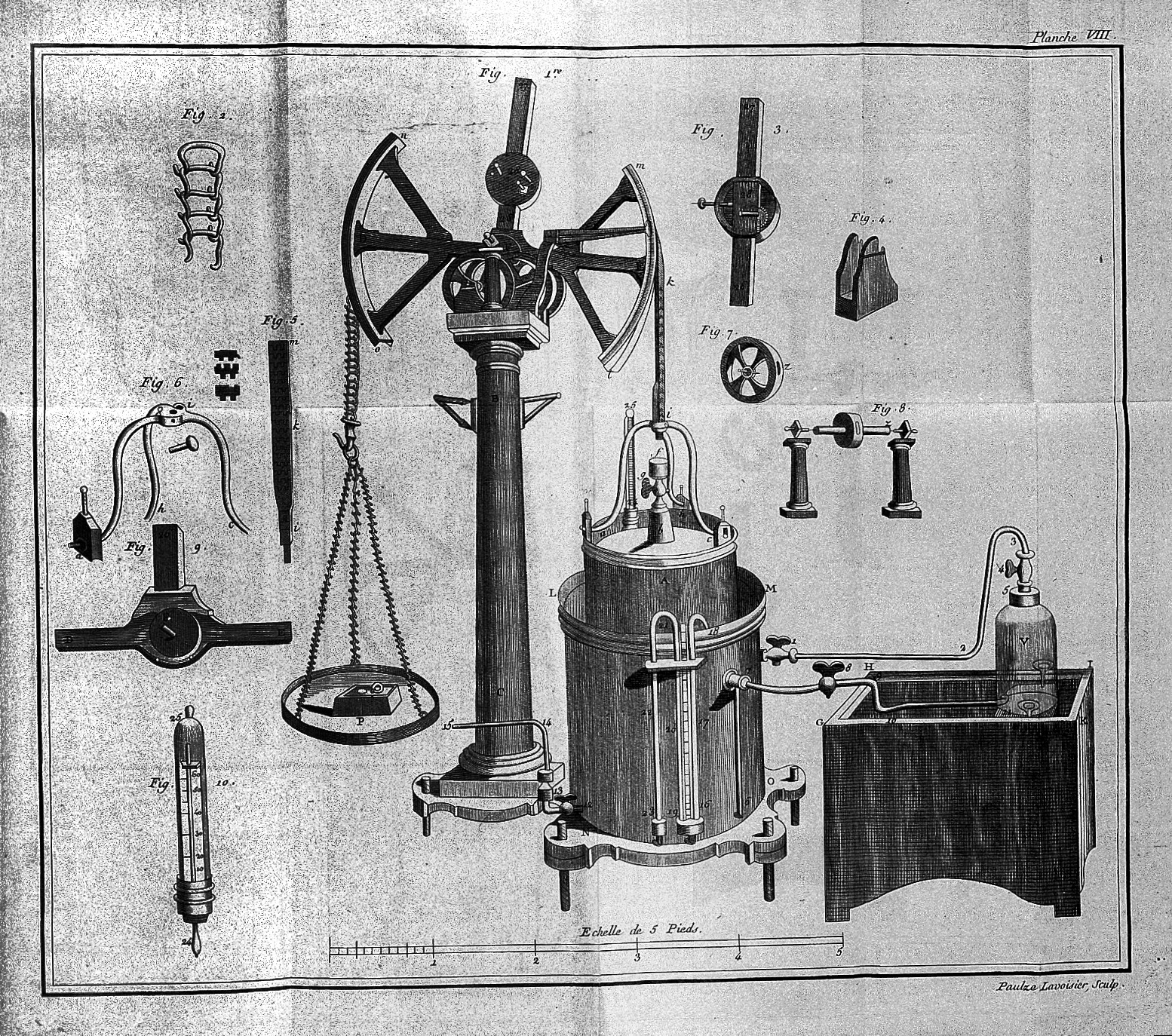
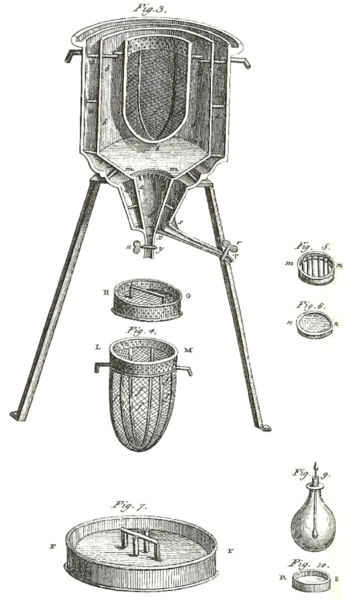
To measure heat from combustion and respiration, Lavoisier and Laplace designed an ice calorimeter: an inner chamber packed with ice around the subject or reaction, surrounded by an outer shell of ice held at 0°C so outside heat couldn’t skew the reading; the melted water was collected and weighed to calculate heat output. It was famously tested on a live guinea pig. Notice the seated figure recording results at the right of the scene — contemporary depictions of the Lavoisier laboratory very often include Marie-Anne, who kept the written record of these experiments (more on her next).
Marie-Anne Paulze Lavoisier — Scientific Partner
Marie-Anne Pierrette Paulze married Antoine in 1771 at age 13 (he was 28); her father was a senior official of the Ferme Générale, and the marriage consolidated Antoine’s standing within it. She became far more than a spouse — she learned English so she could translate key foreign work for Antoine’s use, including Richard Kirwan’s Essay on Phlogiston and papers by Joseph Priestley, assisted directly in the laboratory, edited and helped publish his memoirs, and hosted the gatherings where the leading chemists of Europe argued out open problems.
Marie-Anne Paulze Lavoisier — Illustrator of the Traité
This plate from the Traité élémentaire de chimie (1789) is signed, lower right, “Paulze Lavoisier Sculp.” Marie-Anne trained specifically in drawing and engraving so she could produce the technical illustrations of laboratory apparatus that fill Antoine’s publications — plates precise enough that generations of chemists used them as working diagrams of the instruments described in the text. In effect she was the book’s co-author in visual form, even though only Antoine’s name appears on the title page.
Jacques-Louis David — Marie-Anne’s Art Tutor
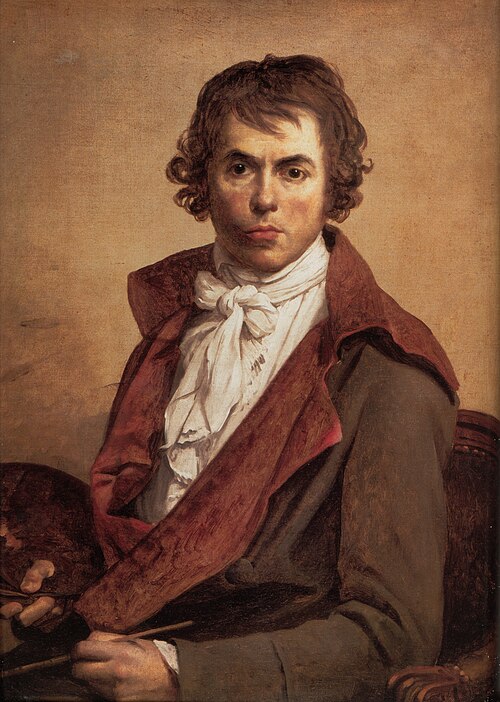
Jacques-Louis David, the leading Neoclassical painter of Revolutionary France, was Marie-Anne’s drawing instructor — training that equipped her to produce the Traité ’s engraved plates. David also painted the celebrated 1788 double portrait of Antoine and Marie-Anne shown earlier, completed on the eve of the Revolution; its planned unveiling at the Paris Salon was withdrawn for fear that its display of aristocratic wealth would inflame anti-aristocratic sentiment. The irony: David went on to become a committed Jacobin and a member of the National Convention that presided over the Terror — the same political current that sent Antoine Lavoisier to the guillotine in 1794.
The Execution of Antoine Lavoisier, 1794
On November 24, 1793, an arrest order went out for all former members of the Ferme Générale. Lavoisier and 27 co-defendants were tried together and guillotined on May 8, 1794 , at age 50.
According to a famous but disputed legend, the judge Jean-Baptiste Coffinhal refused an appeal to let Lavoisier finish an experiment first, saying “The Republic needs neither scholars nor chemists; the course of justice cannot be delayed” — a line the historian Denis Duveen considered almost certainly apocryphal. Coffinhal himself was guillotined less than three months later, during the Thermidorian reaction. The mathematician Joseph-Louis Lagrange mourned Lavoisier’s death: “It took them only an instant to cut off this head, and a hundred years might not suffice to reproduce its like.” Lavoisier was formally exonerated roughly a year and a half after his execution. Worth pairing with the Priestley Riots slide earlier in this deck — two very different scientific reputations, both engulfed by the same revolutionary decade.
Carl Wilhelm Scheele (1742–1786)
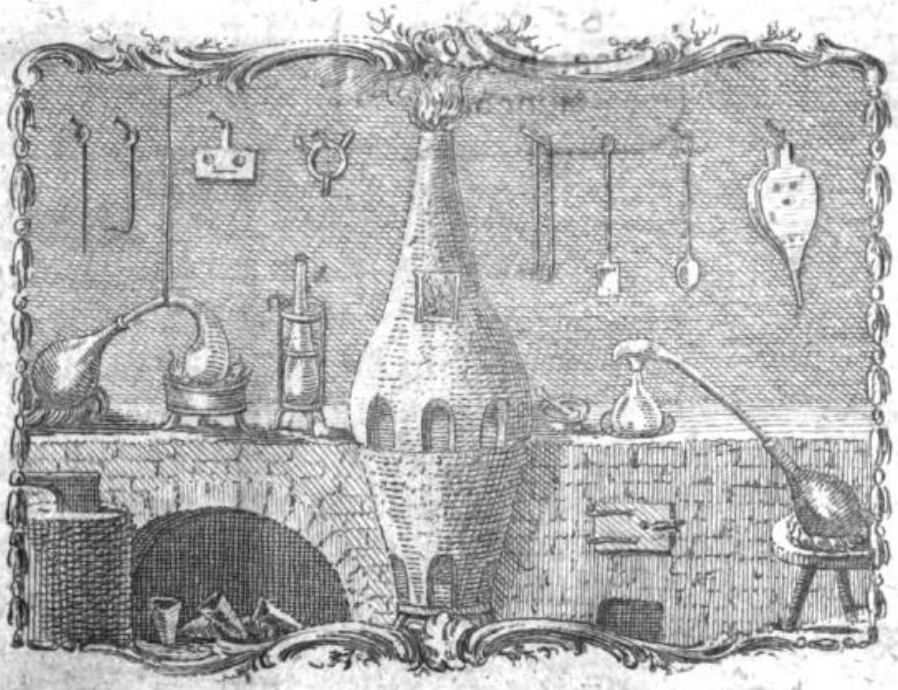
The Swedish-German pharmaceutical chemist Carl Wilhelm Scheele isolated the gas he called “fire air” around 1771–72 — roughly two years before Priestley’s better-known August 1774 experiment — but a slow-moving publisher and his relatively isolated position as a provincial apothecary meant the results weren’t published until 1777, in Chemische Abhandlung von der Luft und dem Feuer (“Chemical Treatise on Air and Fire,” shown here). Because Lavoisier and Priestley’s results reached print and wide circulation faster, Scheele is often left out of popular retellings, even though many historians consider him to have isolated oxygen first. He worked his whole career as a practicing apothecary rather than an academic, discovered several other elements and compounds in the same period (including chlorine and molybdic acid), and died at 43 in 1786 — a death sometimes attributed to his habit of tasting and smelling the toxic chemicals, including arsenic and mercury compounds, he worked with daily.
Other Superceded Scientific Ideas
wikipedia
A list of other scientific ideas that have been superceded, including the geocentric model of the universe, phlogiston theory, and the caloric theory of heat. Useful for illustrating the point that scientific knowledge is provisional and subject to change as new evidence emerges.
Caloric Theory of Heat
The caloric theory of heat, which posited that heat was a weightless fluid that could flow from one body to another, was widely accepted in the 18th and early 19th centuries. It was eventually replaced by the kinetic theory of heat, which describes heat as the motion of particles.
In Antoine Lavoisier’s 1789 Traité élémentaire de chimie, “light” (lumière) appeared as the very first entry on his table of thirty-three simple substances, listed alongside caloric (heat) as one of two weightless “imponderable fluids” rather than as a form of energy or electromagnetic radiation. Lavoisier’s reasoning followed the same experimental logic that led him to oxygen: since light and heat could apparently combine with matter (a burning candle gives off light, a heated metal glows) yet could not be weighed or decomposed into anything simpler, they satisfied his operational definition of an element — a substance not yet resolved into any more basic constituent. The idea proved short-lived even by early-19th-century standards; as thermodynamics and wave theories of light developed through the 1800s (largely through the work of Thomas Young, Augustin-Jean Fresnel, and later James Clerk Maxwell), both caloric and light were dropped from the periodic table entirely and reclassified as forms of energy rather than material substances — making it a tidy example, alongside phlogiston, of a confidently-held “elementary” category that a later paradigm simply dissolved.