Gottfried Wilhelm Leibniz
Calculus, Infinite Series, and the Bernoullis
Gottfried Wilhelm Leibniz (1646–1716)

Philosopher, diplomat, and co-inventor of calculus — and the infinite series that grew out of it.
Early Life
- His father was a professor with a large personal library, which Leibniz read through as a child.
- He entered university at 15, earned a doctorate at 20, and also held a law degree.
- In Paris, he met the Dutch scientist Christiaan Huygens — who had studied the cycloid and Saturn’s rings — and within four years became a mathematical star in his own right.
- Huygens received a pension from Louis XIV, who reigned as King of France from age 4 to 72 and had more than 19 children by seven different mothers.
- Huygens then set Leibniz a problem: find the sum of the reciprocals of the triangular numbers.

Louis XIV, King of France (Hyacinthe Rigaud, 1701).
Leibniz’s Calculating Machine
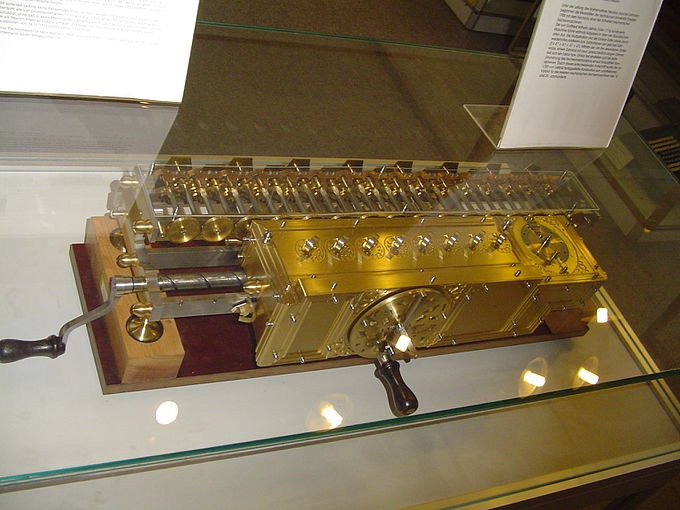
The Stepped Reckoner (Staffelwalze), Leibniz’s mechanical calculator, designed to perform addition, subtraction, multiplication, and division automatically — part of why he’s sometimes called a forerunner of computer science (see “A Universal Genius”).
Jacob Bernoulli (1654–1705)
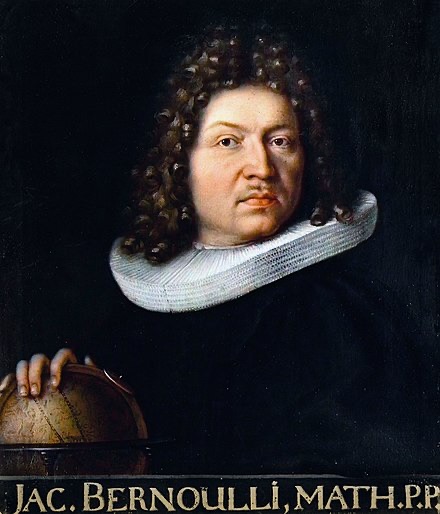
- The elder of the two Bernoulli brothers, by 13 years.
- Defined \(e\) as the limit of \(\left(1 + \frac{1}{x}\right)^x\) as \(x \to \infty\).
- Made foundational contributions to probability, including the law of large numbers.
- Studied the lemniscate — the curve traced by inverting a hyperbola — now named after him.
Johann Bernoulli (1667–1748)
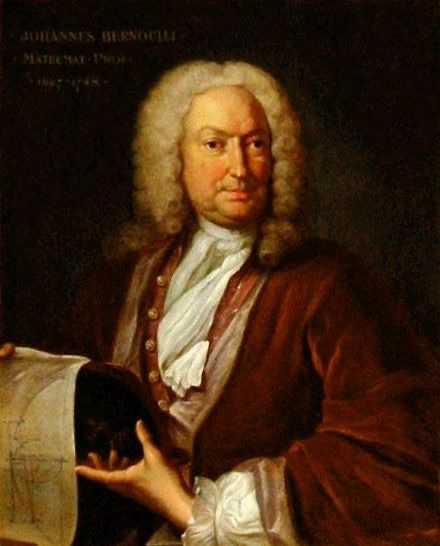
- Jacob’s younger brother, and also a major contributor to calculus and infinite series.
- Was hired to privately tutor the Marquis de l’Hôpital — and effectively wrote the first calculus textbook, which included l’Hôpital’s rule.
- The two brothers were fiercely competitive. After Jacob’s death, Johann grew jealous of Jacob’s son Daniel — and at one point falsely re-dated his own work on hydrodynamics to appear to predate his son’s.