Charniak Ch. 5 companion – based on Ch. 1 of Visual Intelligence (Torralba, Isola & Freeman, visionbook.mit.edu)
HON 201 - Week 9
A Note on These Slides
All images in this deck are reproduced from Visual Intelligence by Antonio Torralba, Phillip Isola, and William Freeman (visionbook.mit.edu), an open-access textbook published under a CC BY-NC-ND license.
They are used here strictly for in-class instructional purposes – not for redistribution, publication, or any commercial use. Full credit belongs to the authors.
Vision Feels Effortless. It Isn’t.
Your eye receives only the light arriving from each direction – nothing more.
The brain turns millions of photoreceptor signals into an interpretation of the world.
Visual illusions prove the point: what you see is not the same as the light that actually reached your eye.
Hans Moravec, roboticist – namesake of Moravec’s Paradox: the things vision makes look effortless (recognizing a face, finding a path across a room) are the hardest things to automate, while the things that feel effortful to us (arithmetic, chess) are comparatively easy for a computer.
What Is Vision, Actually?
Vision is “to know what is where by looking.” – David Marr
Two sources of difficulty:
The structure of the input – what light actually carries.
The structure of the desired output – what we actually want to recover from it.
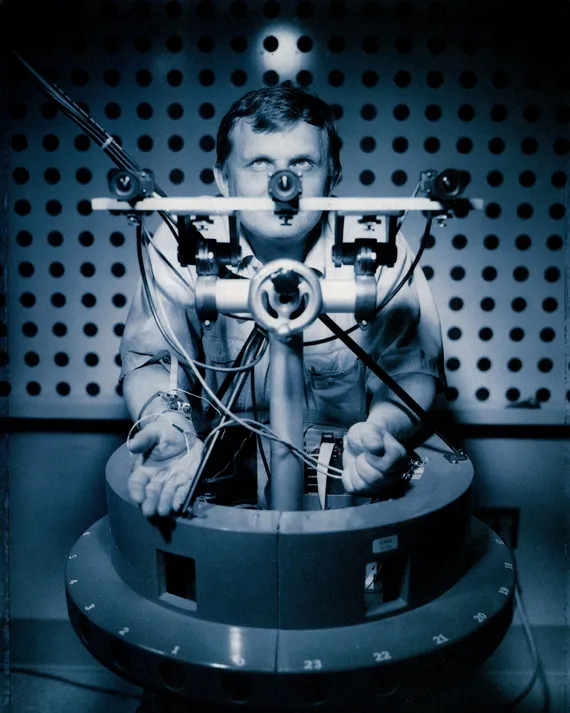
Computer vision is usually studied disembodied – no agent, no task, no body. That omission makes the problem harder, not easier.
The Input: Ambient Light
The Output: Light vs. Scene Properties
Vision is not a fixed function of the image. Prior knowledge, goals, and expectations all shape what you see.
The goal isn’t to measure light like a photometer – it’s to recover the surfaces, objects, and materials that actually matter to the observer.
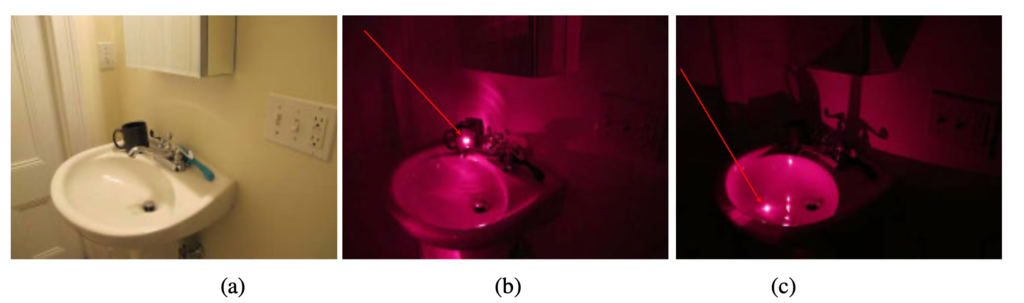
The same point in the same scene, probed with a laser pointer under three different lighting conditions – the measured light swings wildly, even though the underlying surface never changes.
Gestalt Psychology: The Whole, Not the Parts
Began ~1912 with Max Wertheimer’s phi phenomenon – two flashed bars appear to move continuously, even though nothing physically moved between them.
Central claim: perception is about wholes, not an assembly of independent parts.
This becomes perceptual organization – how scattered features get grouped into objects at all.
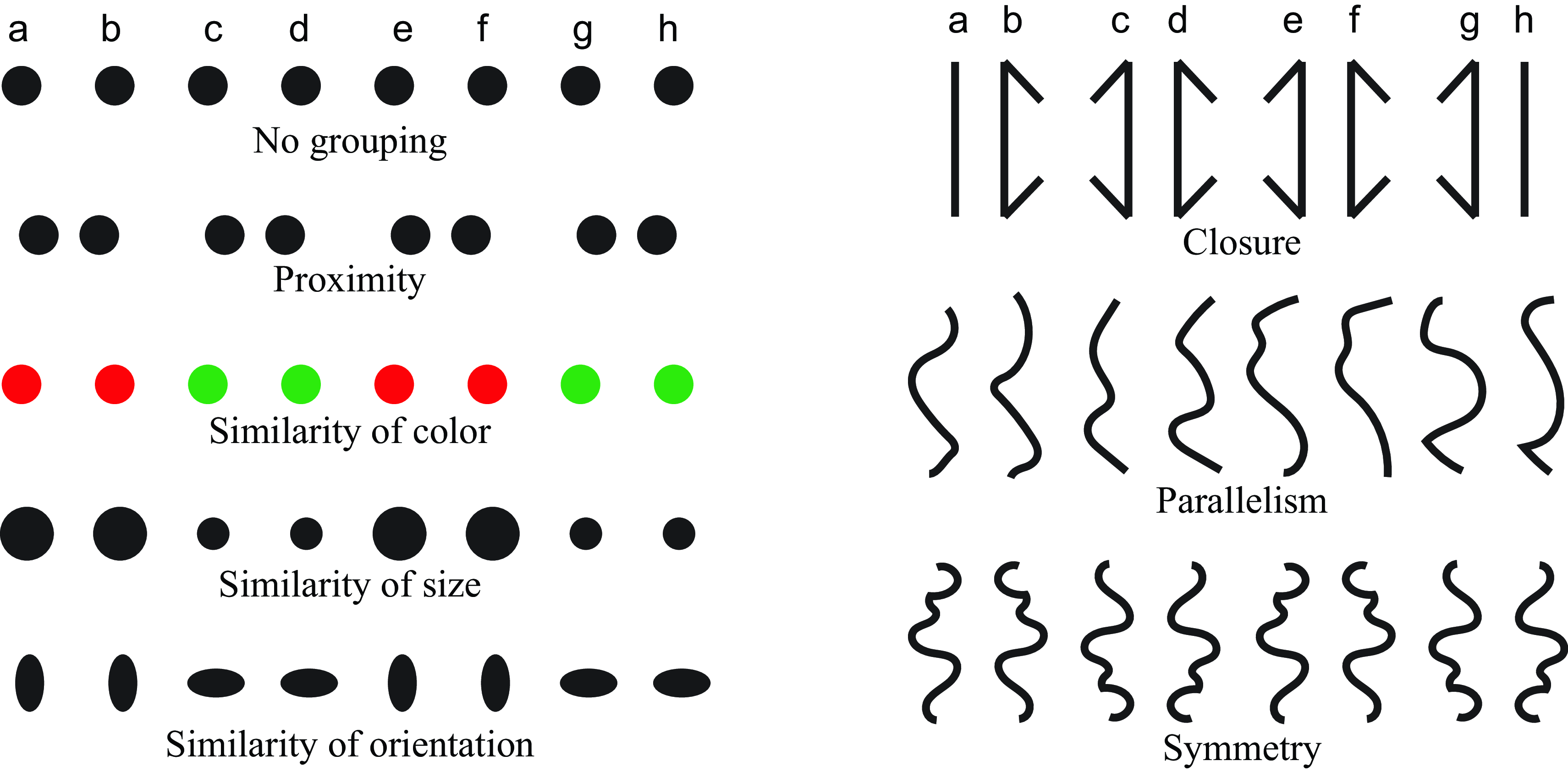
Gestalt’s Grouping Laws
Figure 1.6 – examples of Gestalt grouping rules (after Palmer and Koffka).
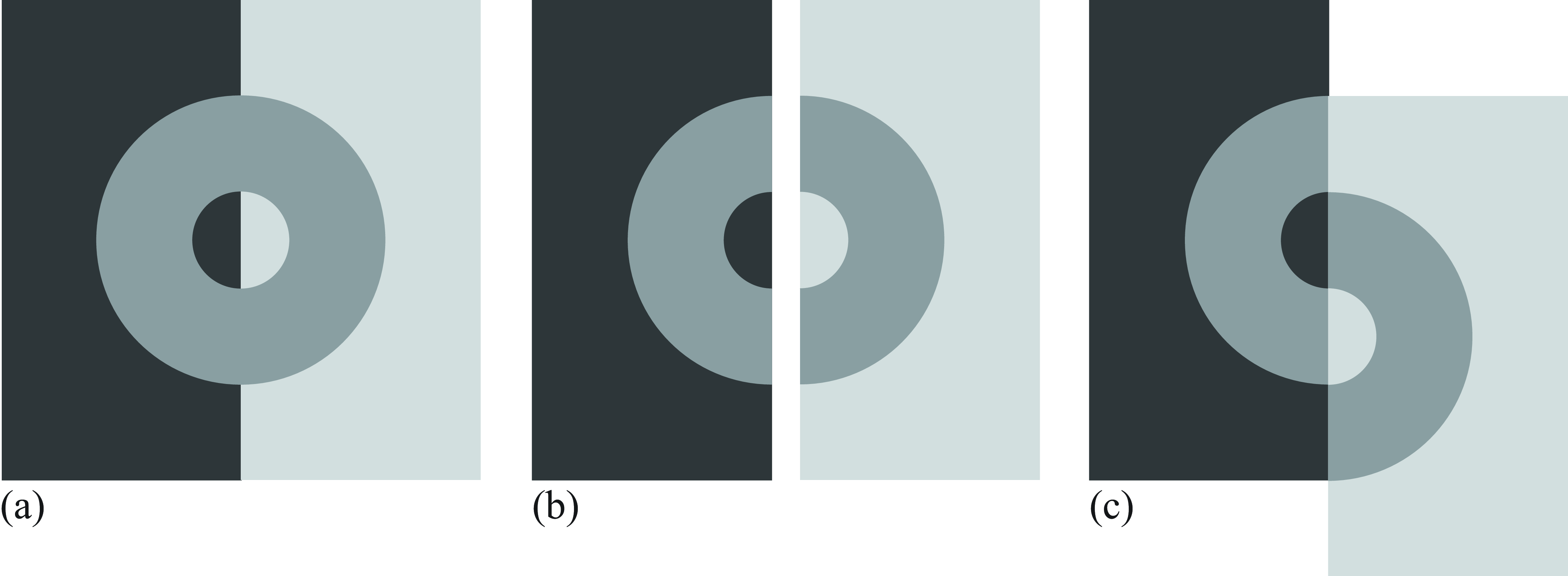
Lightness, Shadows, and Illusory Contours
Figure 1.7 – the Koffka ring: identical gray on both halves, perceived as different.
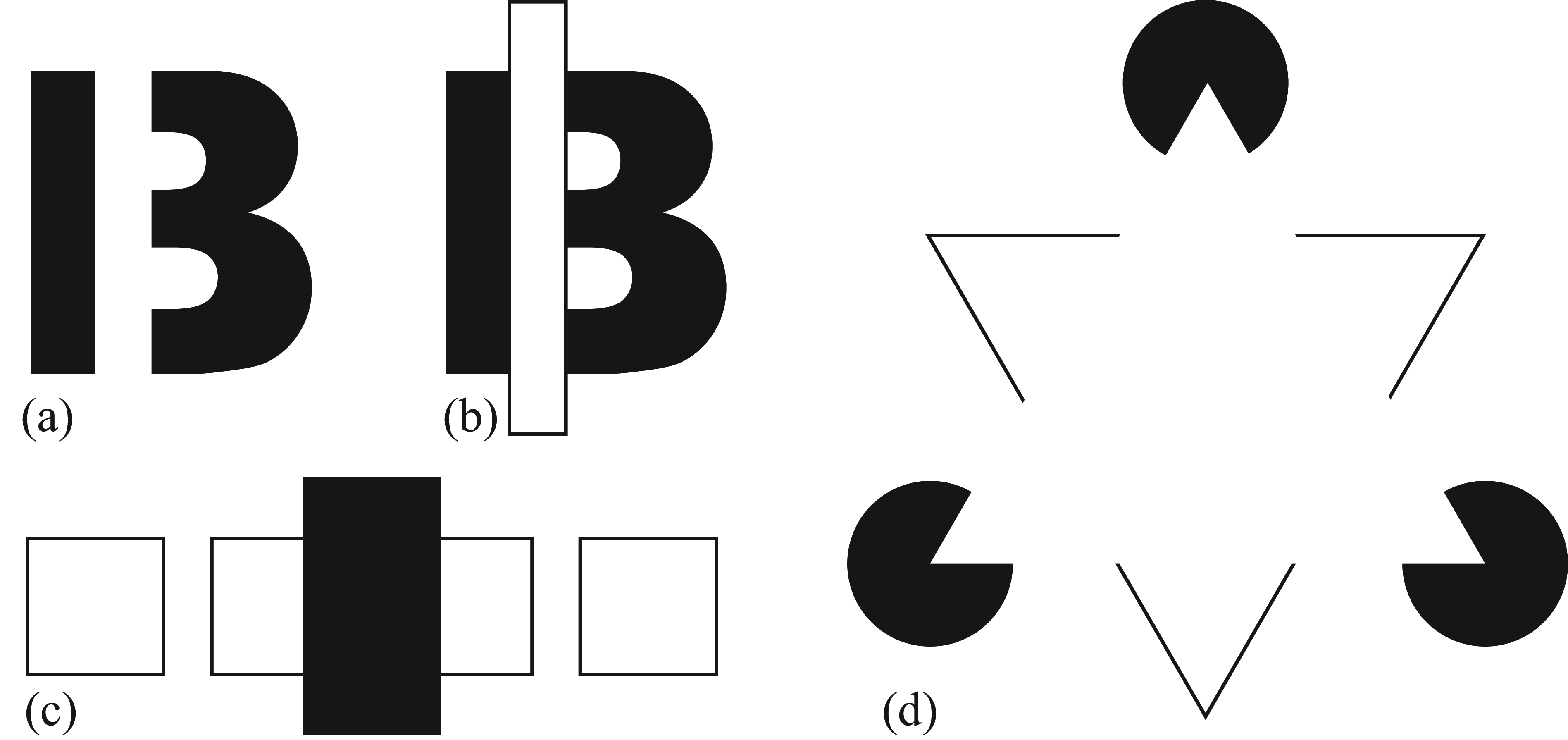
Figure 1.8 – amodal completion (the “B or 13” figure, and a bar seen through overlapping squares) and modal completion (the Kanizsa triangle, bottom right).
Gibson’s Ecological Approach
James J. Gibson’s argument: study vision in the context of a body moving through an environment – not isolated lab stimuli.
The environment: medium, substances, surfaces, change and persistence.
The ground plane matters enormously for any land animal.
Ecological optics: study the ambient optic array actually converging on an observer, not idealized physics.
Affordances and Direct Perception
Affordances: what the environment offers an animal to do – a path affords walking, an obstacle affords collision, a staircase affords climbing.
Direct perception: the ambient optic array is already rich enough that perceiving is closer to picking up information than to inferring it.
Contrast: the indirect view holds that the input is impoverished, and the brain must supplement it with extra computation.
How the Eye Itself Works
(Section 1.3.5, neurophysiology – skipped from today’s main throughline, included here as an optional aside.)
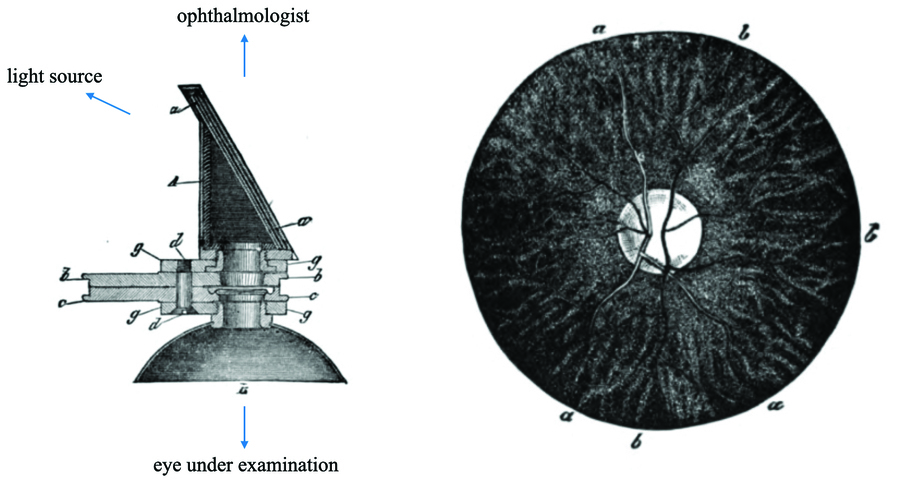
Helmholtz’s ophthalmoscope (1850): the first instrument letting a doctor look directly at a living retina.
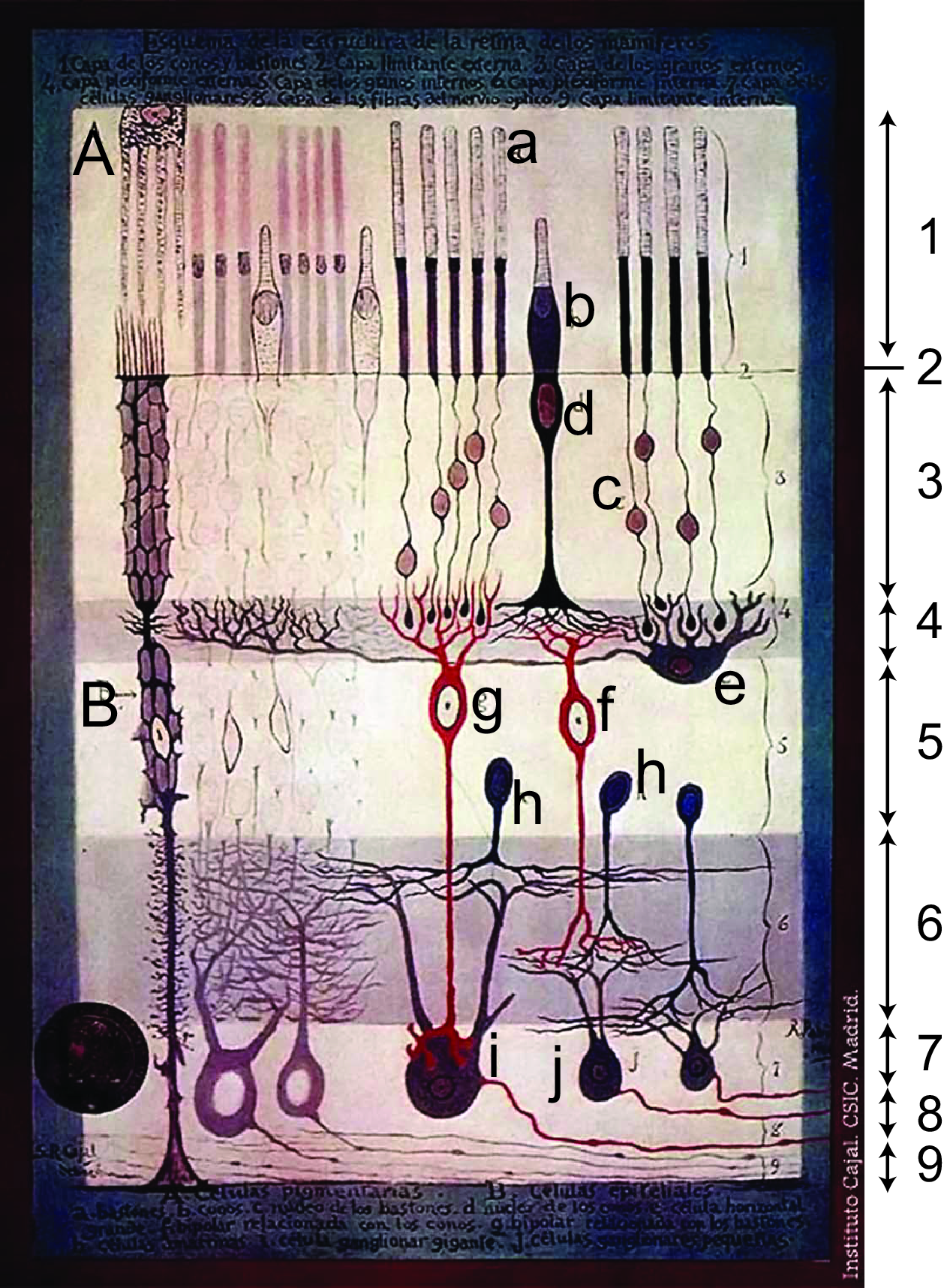
Cajal’s drawing of the retina’s own layered circuitry: photoreceptors feeding bipolar and horizontal cells, feeding ganglion cells, whose axons leave as the optic nerve.
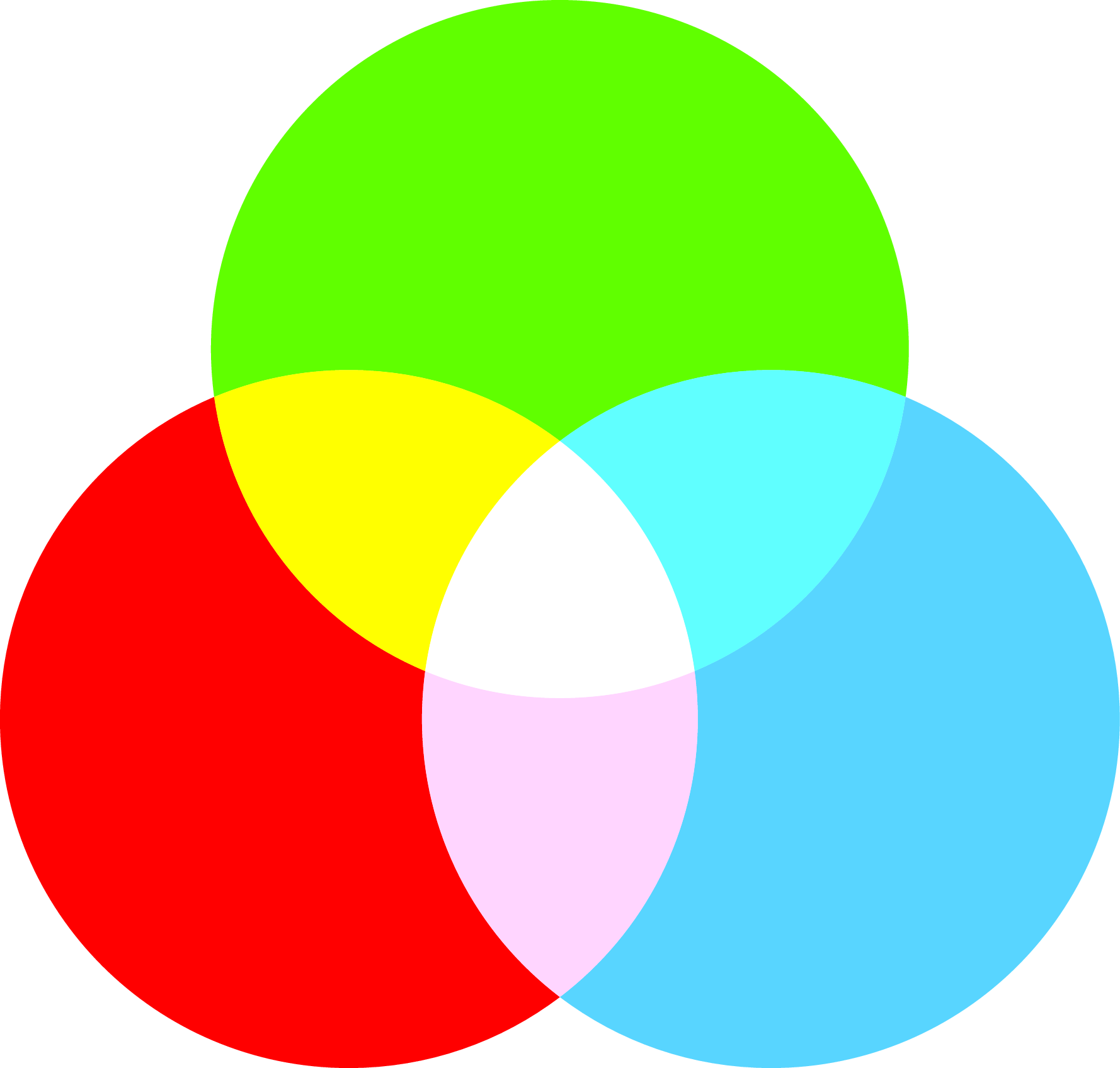
Young-Helmholtz trichromatic theory: three overlapping primaries (red, green, blue) explain the full range of perceived color.
Marr’s Computational Theory of Vision
Published posthumously, 1982 (Marr died of leukemia in 1980, age 35). Framed vision as an information-processing task, analyzable at three independent but loosely coupled levels:
Computational theory – what is the task, and why does it need solving?
Representation and algorithm – how are inputs/outputs encoded, and what procedure transforms one into the other?
Hardware implementation – what physical substrate (silicon, or neurons) actually carries it out?
Marr’s Sequence of Representations
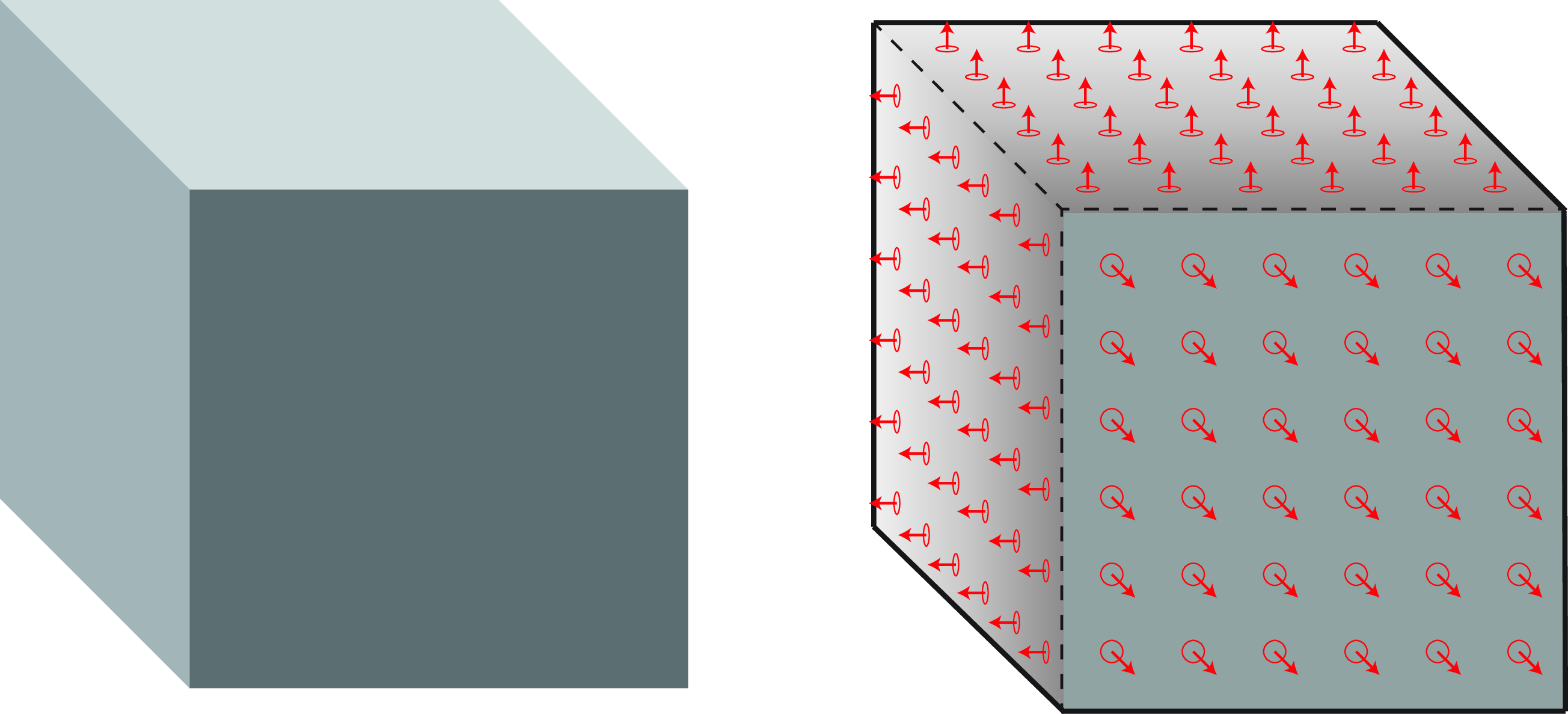
Image (raw pixel intensities) -> Primal sketch (edges, junctions, zero-crossings) -> 2.5D sketch (depth map + surface orientation, viewer-centered) -> 3D model (objects as shapes, arranged in space)
Figure 1.14 – a cube and its 2.5D sketch: red arrows are “gauge figures,” a visualization convention showing estimated surface orientation at each point.
1990-2000 – shift toward measuring real ecological image properties: segmentation, texture modeling, early learning-based face detection. Digital cameras become common.
(Larry Roberts earned the first computer-vision PhD at MIT in 1963 – the same Larry Roberts from the blocks-world material two chapters ago.)
Computer Vision, 2000-2020: Recognition, Then Learning
2000-2010 – focus shifts to classification and recognition. Benchmarks appear (Caltech 101, PASCAL, LabelMe, CIFAR). Hand-designed descriptors (SIFT, HOG, GIST) feed classifiers (SVMs, boosting). Large datasets like ImageNet appear – but architectures and features are still mostly hand-designed.
2010-2020 – deep learning comes to dominate every area of computer vision.
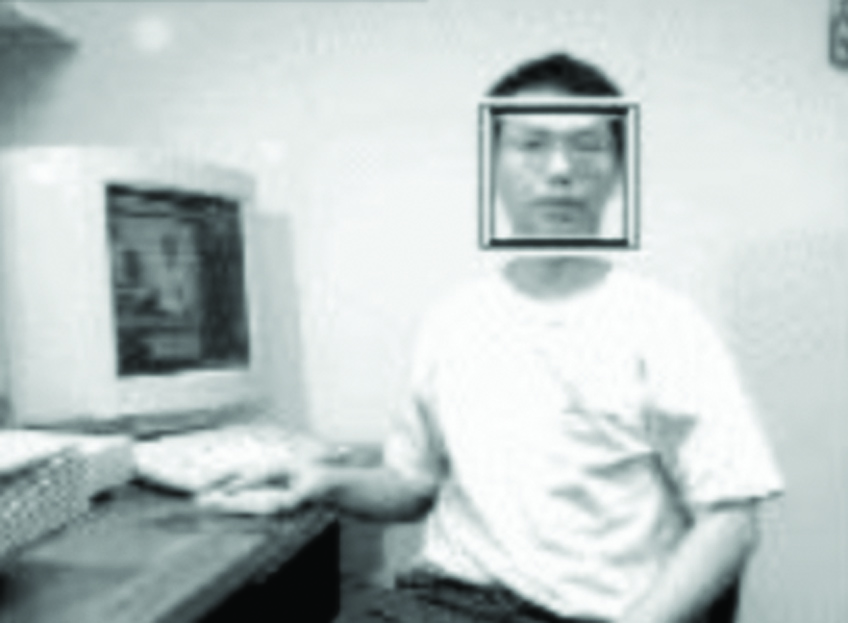
An early-2000s learned face detector locating a face in a real photo (Viola-Jones-era) – the decade’s standout non-neural recognition success.
Learning-Based Vision and the Rise and Fall of Neural Nets
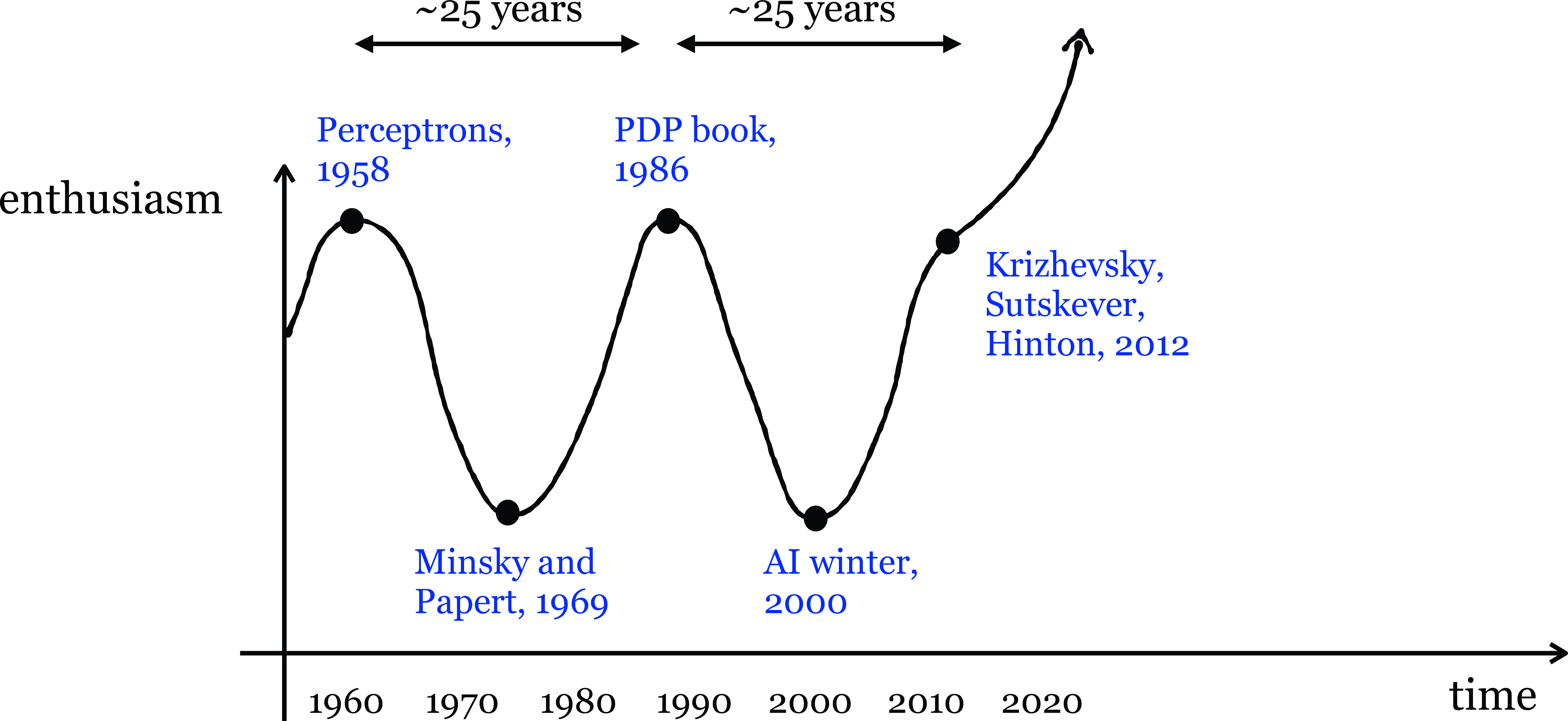
Figure 1.16 – enthusiasm for neural networks has risen and fallen on a cycle of roughly 25 years. What happens next?
The ImageNet Moment (2012)
AlexNet dramatically outperformed every prior method at the ImageNet competition – trained end-to-end, straight from raw pixels to output predictions, with no hand-designed features in between.
After 2012, learning became central to nearly all computer vision research.
What’s Next? (Section 1.4)
Vision theory has been under construction for over 2,000 years – from Greek extramission theories to modern neuroscience and deep learning. Each stage revealed something the last one missed.
Named gaps still open today:
Visual common sense – now being explored with large language models.
Integration with the other senses.
A theory of embodied perception – the chapter calls this the most important missing piece.