The Fundamental Group of the Circle
MA516: Topology | Munkres §54
The Fundamental Group (§52)
Let \(x_0 \in X\). The Fundamental Group of \(X\) relative to \(x_0\), denoted \(\pi_1(X, x_0)\), is the set of path homotopy classes of loops based at \(x_0\).
Group Operations:
- Product: \([f] * [g] = [f * g]\) (Concatenation)
- Identity: \([e_{x_0}]\) (The constant loop)
- Inverse: \([\bar{f}]\) (The reverse path)
- Associativity: \(([f] * [g]) * [h] = [f] * ([g] * [h])\)
How \(\pi_1\) depends on basepopint
Let \(\alpha\) be a path from \(x_0\) to \(x_1\). Then we can define a map \(\hat\alpha: \pi_1(X, x_0) \to \pi_1(X, x_1)\) by \(\phi([f]) = [\bar{\alpha}] * [f] * [\alpha]\).
- \(\hat\alpha\) is well-defined: (It doesn’t depend on the choice of representative). Two representatives, \(f\) and \(f'\) imply \(f \sim f'\) thus \([f] = [f']\), then \(\hat\alpha([f]) = [\bar{\alpha}] * [f] * [\alpha] = [\bar{\alpha}] * [f'] * [\alpha]\).
- \(\hat\alpha\) is a homomorphism: \(\hat\alpha([f] * [g]) = \bar{\alpha} * (f * g) * \alpha = (\bar{\alpha} * f * \alpha) * (\bar{\alpha} * g * \alpha) = \hat\alpha([f]) * \hat\alpha([g])\).
- It is injective since if \(\hat\alpha([f]) = \hat\alpha([g])\) then \([\bar{\alpha}] * [f] * [\alpha] = [\bar{\alpha}] * [g] * [\alpha]\) implies \([f] = [g]\). This says that if a loop based at \(x_0\) becomes nullhomotopic when “transported” to \(x_1\) via \(\alpha\), then it must have been nullhomotopic to begin with. This is because the path \(\alpha\) is a homotopy equivalence between the loops based at \(x_0\) and the loops based at \(x_1\). So if a loop becomes trivial after being “conjugated” by \(\alpha\), it must have been trivial in the first place.
- It is surjective since for any \([h] \in \pi_1(X, x_1)\), we have \(\hat\alpha([\alpha * h * \bar{\alpha}]) = [\bar{\alpha}] * [\alpha * h * \bar{\alpha}] * [\alpha] = [h]\). Notice the order of the \([\alpha]\) and \([\bar{\alpha}]\) is reversed. This is because, in the current hypothesis, \(h\) is a loop based at \(x_1\), so we need to “transport” it back to \(x_0\) using \(\alpha\) and \(\bar{\alpha}\). The path \(\alpha\) lets us turn any loop based at \(x_0\) into a loop based at \(x_1\) by “conjugating” it with \(\alpha\) and \(\bar{\alpha}\). This is a standard technique in algebraic topology.
This map is an isomorphism of groups. So the fundamental group does not depend on the choice of basepoint up to isomorphism.
Theorem: If \(X\) is path-connected, then \(\pi_1(X, x_0) \cong \pi_1(X, x_1)\) for any \(x_0, x_1 \in X\).
To see where path-connectivity is important, consider a space where one glues (via the wedge construction) a circle whose x-coordinates are all negative or zero to the the origin of the topologist’s sine curve. The fundament group of the resulting space will be trivial if the basepoint has positive x-coordinate but will be isomorphic to \(\mathbb{Z}\) if the basepoint has negative x-coordinate. So the fundamental group can depend on the choice of basepoint if the space is not path-connected.
Simply Connected Spaces
A space \(X\) is simply connected if \(\pi_1(X, x_0) = \{0\}\) for some (and hence any) \(x_0 \in X\). In other words, every loop in \(X\) can be contracted to a point. Examples of simply connected spaces include \(\mathbb{R}^n\), the disk \(D^2\), and the sphere \(S^n\) for \(n \geq 2\). The circle \(S^1\) is not simply connected as we will soon see.
The following Lemma is not surprising:
Lemma: If \(X\) is simply connected, then any two paths in \(X\) with the same endpoints are homotopic relative to their endpoints.
Proof: Let \(f, g: [0,1] \to X\) be two paths with the same endpoints. Then \(f * \bar{g}\) is a loop based at the common endpoint. By assumption, it is nullhomotopic. Thus\([f * \bar{g}] = [e_{x_0}]\). Remembering \([f * \bar{g}] = [f] * [\bar{g}]\), we then have
\([f] * [\bar{g}] * [g] = [f * \bar{g}] * [g] = [e_{x_0}] * [g] = [g]\) implies \([f] = [g]\) since we can associate on the right to see \([f] * ([\bar{g}] * [g]) = [f] * [e_{x_0}] = [f]\). So \([f] = [g]\) and thus \(f\) and \(g\) are homotopic relative to their endpoints.
The Induced Homomorphism
Continuous maps push loops forward. This induces a map on fundamental groups. If \(f: (X, x_0) \to (Y, y_0)\) is a continuous map such that \(f(x_0) = y_0\), then we can define a map \(f_*: \pi_1(X, x_0) \to \pi_1(Y, y_0)\) by \(f_*([g]) = [f \circ g]\). This map \(f_*\) is called the induced homomorphism on \(\pi_1\).
- It’s well-defined: If \(g \sim g'\) then \([g] = [g']\). Then \(f_*([g]) = [f \circ g]\). The homotopy between \(g\) and \(g'\) when composed with \(f\) is a homotopy between \(f \circ g\) and \(f \circ g'\), so \([f \circ g] = [f \circ g']\) thus \(f_*([g]) = f_*([g'])\).
- It’s a homomorphism: The main tool is: the product of two images of loops is the image of the product of those loops. In other words, \(f \circ (g * h) = (f \circ g) * (f \circ h)\), which is true by the definition of path concatenation and composition of functions. Thus, we have: \(f_*([g] * [h]) = f_*([g * h]) = [f \circ (g * h)] = [f \circ g] * [f \circ h] = f_*([g]) * f_*([h])\).
- Changing the base point will generally change the induced homomorphism, but only by an inner automorphism. In other words, if \(\alpha\) is a path from \(y_0\) to \(y_1\), then we have a commutative diagram.
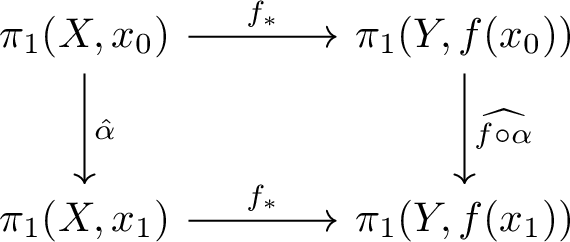
The Functoriality of \(\pi_1\)
If \(f: (X, x_0) \to (Y, y_0)\) and \(g: (Y, y_0) \to (Z, z_0)\) are continuous maps such that \(f(x_0) = y_0\) and \(g(y_0) = z_0\), then we have:
- \((g \circ f)_* = g_* \circ f_*\): For any \([h] \in \pi_1(X, x_0)\), we have \[(g \circ f)_*([h]) = [(g \circ f) \circ h] = [g \circ (f \circ h)] = g_*([f \circ h]) = g_*(f_*([h]))\]
- \((\text{id}_X)_* = \text{id}_{\pi_1(X, x_0)}\): For any \([h] \in \pi_1(X, x_0)\), we have \[(\text{id}_X)_*([h]) = [\text{id}_X \circ h] = [h]\]
1. Defining the Functor \(\pi_1\)
To understand the “Functoriality” of the fundamental group, we look at how \(\pi_1\) preserves the structure of the category of topological spaces.
- Mapping Objects: For every pointed space \((X, x_0)\), \(\pi_1\) assigns a group \(\pi_1(X, x_0)\).
- Mapping Morphisms: For every continuous map \(f: (X, x_0) \to (Y, y_0)\), \(\pi_1\) assigns a group homomorphism \(f_*\).
\[ \begin{matrix} (X, x_0) & \xrightarrow{\text{Continuous Map } f} & (Y, y_0) \\ \downarrow & & \downarrow \\ \pi_1(X, x_0) & \xrightarrow{\text{Homomorphism } f_*} & \pi_1(Y, y_0) \end{matrix} \]
2. The Axioms of Functoriality
For \(\pi_1\) to be a well-defined covariant functor, it must satisfy two “Golden Rules”:
Identity Preservation
The identity map \(id_X: X \to X\) induces the identity homomorphism on the group: \[(id_X)_* = id_{\pi_1(X, x_0)}\]
Composition Preservation
If we have continuous maps \(f: X \to Y\) and \(g: Y \to Z\), the induced homomorphism of the composition is the composition of the induced homomorphisms: \[(g \circ f)_* = g_* \circ f_*\]
Covering Maps
A continuous, surjective map \(p: E \to B\) is a covering map if for every \(b \in B\), there exists an open neighborhood \(U\) of \(b\) such that \(p^{-1}(U)\) is a disjoint union of open sets in \(E\), each of which is homeomorphic to \(U\) via \(p\). (It is evenly covered)
Covering maps are local homeomorphisms, but they can have interesting global properties. They allow us to “lift” paths and homotopies from the base space \(B\) to the covering space \(E\). This is crucial for understanding the fundamental group of spaces like the circle.
Example 1
Consider the map \(p: \mathbb{R} \to S^1\) defined by: \[p(x) = (\cos 2\pi x, \sin 2\pi x)\]
- This is a covering map.
- It “unrolls” the circle into the infinite real line.
Example 2
Torus \(T^2\) can be covered by \(\mathbb{R}^2\) via the map: \[p(x, y) = (e^{2\pi i x}, e^{2\pi i y})\]
Example 3
Figure 8 space can be covered by an infinite grid of circles, each circle covering one loop of the figure 8.
Example 4
The Möbius strip can be covered by a cylinder, which in turn can be covered by the plane.
Lifts
Let \(p: E \to B\) be a covering map and \(f: X \to B\) be a continuous map. A lift of \(f\) is a continuous map \(\tilde{f}: X \to E\) such that \(p \circ \tilde{f} = f\).
The main tools are that lifts exist and are unique under certain conditions. These are known as the Path Lifting Lemma and the Homotopy Lifting Lemma.
Path Lifting Lemma: Given a path \(f: [0, 1] \to B\) starting at \(b_0\), there is a unique path \(\tilde{f}: [0, 1] \to E\) starting at a chosen point \(e_0\) in the fiber over \(b_0\) such that: \[p \circ \tilde{f} = f\]
Homotopy Lifting Lemma: Given a homotopy \(F: X \times [0, 1] \to B\) and a lift \(\tilde{F}_0: X \to E\) of \(F(-, 0)\), there is a unique homotopy \(\tilde{F}: X \times [0, 1] \to E\) such that: \[p \circ \tilde{F} = F\]
The prrofs are based on the local homeomorphism property of covering maps, which allows us to “lift” paths and homotopies step by step, ensuring continuity and uniqueness at each stage.
One of the key consequence:
Theorem: Two path homotopic paths in \(B\) lift to two path homotopic paths in \(E\). In particular, if a loop in \(B\) is nullhomotopic, then any lift of that loop is also nullhomotopic.
Another is the lifting correspondence:
Definition: The lifting correspondence \[\phi: \pi_1(B, b_0) \to p^{-1}(b_0)\] is defined by \(\phi([f]) = \tilde{f}(1)\), where \(\tilde{f}\) is the unique lift of \(f\) starting at \(e_0\).
It is theorem that this is a surfjection for intermediate covers and a bijection when the cover is simply connected:
Theorem: Let \(p: E \to B\) be a covering map and \(e_0 \in E\) such that \(p(e_0) = b_0\). Then the lifting correspondence \(\phi: \pi_1(B, b_0) \to p^{-1}(b_0)\) is a surjection. Moreover, if \(E\) is simply connected, then \(\phi\) is a bijection between the set of path homotopy classes of loops in \(B\) based at \(b_0\) and the set of points in the fiber over \(b_0\).
From this we can finally prove that the fundamental group of the circle is isomorphic to \(\mathbb{Z}\), since the universal cover of \(S^1\) is \(\mathbb{R}\), which is simply connected, and the fiber over the base point consists of all integers (the winding numbers). The only thing to show is that the group operation on \(\pi_1(S^1, b_0)\) corresponds to addition of integers under this bijection, which follows from the properties of path concatenation and lifting.
Theorem: \(\pi_1(S^1, b_0) \cong \mathbb{Z}\)
Every loop in the circle is essentially just “winding” around the center \(n\) times.
Later
Why does this matter?
If we can prove \(\pi_1(S^1) \neq \{0\}\), we get: 1. Brouwer Fixed Point Theorem: Any map \(f: D^2 \to D^2\) has a fixed point. 2. Borsuk-Ulam Theorem: You can’t map \(S^2\) into \(\mathbb{R}^2\) without collapsing two antipodal points.
Impossibility Proofs
Functoriality allows us to translate topological problems into algebraic ones. If a certain map cannot exist in the “Group world,” the corresponding map cannot exist in the “Space world.”
Example: The No-Retraction Theorem If there were a retraction \(r: D^2 \to S^1\), then by functoriality, the following diagram must commute:
\[ \begin{matrix} \pi_1(S^1) & \xrightarrow{i_*} & \pi_1(D^2) & \xrightarrow{r_*} & \pi_1(S^1) \\ \mathbb{Z} & \xrightarrow{\quad \quad} & 0 & \xrightarrow{\quad \quad} & \mathbb{Z} \\ n & \mapsto & 0 & \mapsto & 0 \end{matrix} \]
The Contradiction: Since \(r \circ i = id_{S^1}\), functoriality requires \((r \circ i)_* = id_{\mathbb{Z}}\). But as shown above, the composition \(r_* \circ i_*\) maps everything to \(0\). Thus, no such retraction \(r\) can exist.