The Fundamental Group of the Circle
Fundamental Groups Covering Maps
The Induced Homomorphism
Continuous maps push loops forward. This induces a map on fundamental groups. If \(f: (X, x_0) \to (Y, y_0)\) is a continuous map such that \(f(x_0) = y_0\), then we can define a map \(f_*: \pi_1(X, x_0) \to \pi_1(Y, y_0)\) by \(f_*([g]) = [f \circ g]\). This map \(f_*\) is called the induced homomorphism on \(\pi_1\).
- It’s well-defined: If \(g \sim g'\) then \([g] = [g']\). Then \(f_*([g]) = [f \circ g]\). The homotopy between \(g\) and \(g'\) when composed with \(f\) is a homotopy between \(f \circ g\) and \(f \circ g'\), so \([f \circ g] = [f \circ g']\) thus \(f_*([g]) = f_*([g'])\).
- It’s a homomorphism: The main tool is: the product of two images of loops is the image of the product of those loops. In other words, \(f \circ (g * h) = (f \circ g) * (f \circ h)\), which is true by the definition of path concatenation and composition of functions. Thus, we have: \(f_*([g] * [h]) = f_*([g * h]) = [f \circ (g * h)] = [f \circ g] * [f \circ h] = f_*([g]) * f_*([h])\).
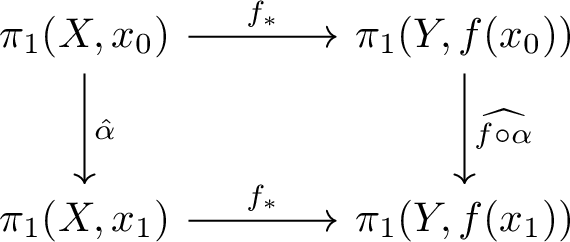
- Changing the base point will generally change the induced homomorphism, but only by an inner automorphism. In other words, if \(\alpha\) is a path from \(y_0\) to \(y_1\), then we have a commutative diagram.
The Functoriality of \(\pi_1\)
If \(f: (X, x_0) \to (Y, y_0)\) and \(g: (Y, y_0) \to (Z, z_0)\) are continuous maps such that \(f(x_0) = y_0\) and \(g(y_0) = z_0\), then we have:
- \((g \circ f)_* = g_* \circ f_*\): For any \([h] \in \pi_1(X, x_0)\), we have \[(g \circ f)_*([h]) = [(g \circ f) \circ h] = [g \circ (f \circ h)] = g_*([f \circ h]) = g_*(f_*([h]))\]
- \((\text{id}_X)_* = \text{id}_{\pi_1(X, x_0)}\): For any \([h] \in \pi_1(X, x_0)\), we have \[(\text{id}_X)_*([h]) = [\text{id}_X \circ h] = [h]\]
The Functor \(\pi_1\)
To understand the “Functoriality” of the fundamental group, we look at how \(\pi_1\) preserves the structure of the category of topological spaces.
- Mapping Objects: For every pointed space \((X, x_0)\), \(\pi_1\) assigns a group \(\pi_1(X, x_0)\).
- Mapping Morphisms: For every continuous map \(f: (X, x_0) \to (Y, y_0)\), \(\pi_1\) assigns a group homomorphism \(f_*\).
\[ \begin{matrix} (X, x_0) & \xrightarrow{\text{Continuous Map } f} & (Y, y_0) \\ \downarrow & & \downarrow \\ \pi_1(X, x_0) & \xrightarrow{\text{Homomorphism } f_*} & \pi_1(Y, y_0) \end{matrix} \]
The Axioms of Functoriality
For \(\pi_1\) to be a well-defined covariant functor, it must satisfy two “Golden Rules”:
Identity Preservation
The identity map \(id_X: X \to X\) induces the identity homomorphism on the group: \[(id_X)_* = id_{\pi_1(X, x_0)}\]
Composition Preservation
If we have continuous maps \(f: X \to Y\) and \(g: Y \to Z\), the induced homomorphism of the composition is the composition of the induced homomorphisms: \[(g \circ f)_{*} = g_{*} \circ f_{*}\]
Covering Maps
A continuous, surjective map \(p: E \to B\) is a covering map if for every \(b \in B\), there exists an open neighborhood \(U\) of \(b\) such that \(p^{-1}(U)\) is a disjoint union of open sets in \(E\), each of which is homeomorphic to \(U\) via \(p\). (It is evenly covered)
Covering maps are local homeomorphisms, but they can have interesting global properties. They allow us to “lift” paths and homotopies from the base space \(B\) to the covering space \(E\). This is crucial for understanding the fundamental group of spaces like the circle.
Example 1
Consider the map \(p: \mathbb{R} \to S^1\) defined by: \[p(x) = (\cos 2\pi x, \sin 2\pi x)\]
This is a covering map.
It “unrolls” the circle into the infinite real line.
Example 2
Torus \(T^2\) can be covered by \(\mathbb{R}^2\) via the map: \[p(x, y) = (e^{2\pi i x}, e^{2\pi i y})\]
Example 3
Figure 8 space can be covered by an infinite grid of circles, each circle covering one loop of the figure 8.
Example 4
The Möbius strip can be covered by a cylinder, which in turn can be covered by the plane.
Lifts
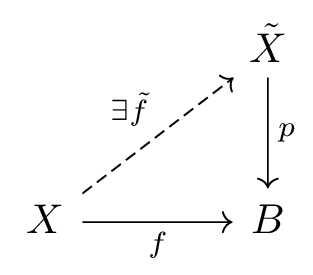
Let \(p: E \to B\) be a covering map and \(f: X \to B\) be a continuous map. A lift of \(f\) is a continuous map \(\tilde{f}: X \to E\) such that \(p \circ \tilde{f} = f\).
The main tools are that lifts exist and are unique under certain conditions. These are known as the Path Lifting Lemma and the Homotopy Lifting Lemma.
Path Lifting Lemma: Given a path \(f: [0, 1] \to B\) starting at \(b_0\), there is a unique path \(\tilde{f}: [0, 1] \to E\) starting at a chosen point \(e_0\) in the fiber over \(b_0\) such that: \[p \circ \tilde{f} = f\]
Example: If we have a loop in \(S^1\) that winds around the circle twice, its lift to \(\mathbb{R}\) will be a path that starts at some point and ends at a point that is two units away, reflecting the winding number.
Example: The wedge of two circles is a space that has a cover (an intetrmediate cover) that is an infinite string of circles, each circle covering one of the loops in the wedge. A loop in the wedge that goes around each circle once and then back around the first circle again will lift to a path in the cover that goes around the first circle, then down the path to the second circle, then again around the next circle.
Note: In both of the examples above, note how the lift of a lop depends on the choice of the starting point in the fiber. If we had chosen a different starting point, we would have gotten a different lift.
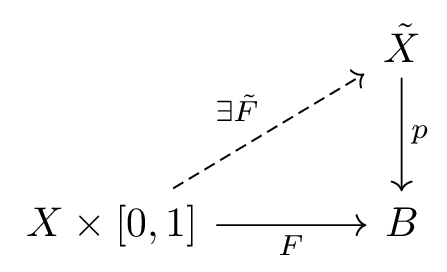
Homotopy Lifting Lemma: Given a homotopy \(F: X \times [0, 1] \to B\) and a lift \(\tilde{F}_0: X \to E\) of \(F(-, 0)\), there is a unique homotopy \(\tilde{F}: X \times [0, 1] \to E\) such that: \[p \circ \tilde{F} = F\]
The proofs are based on the local homeomorphism property of covering maps, which allows us to “lift” paths and homotopies step by step, ensuring continuity and uniqueness at each stage.
Lifting Visualization homotopy lifting
Theorems:
Theorem: Two path homotopic paths in \(B\) lift to two path homotopic paths in \(E\). In particular, if a loop in \(B\) is nullhomotopic, then any lift of that loop is also nullhomotopic.
Another is the lifting correspondence:
Definition: The lifting correspondence \[\phi: \pi_1(B, b_0) \to p^{-1}(b_0)\] is defined by \(\phi([f]) = \tilde{f}(1)\), where \(\tilde{f}\) is the unique lift of \(f\) starting at \(e_0\).
It is theorem that this is a surfjection for intermediate covers and a bijection when the cover is simply connected:
Theorem: Let \(p: E \to B\) be a covering map and \(e_0 \in E\) such that \(p(e_0) = b_0\). Then the lifting correspondence \(\phi: \pi_1(B, b_0) \to p^{-1}(b_0)\) is a surjection. Moreover, if \(E\) is simply connected, then \(\phi\) is a bijection between the set of path homotopy classes of loops in \(B\) based at \(b_0\) and the set of points in the fiber over \(b_0\).
From this we can finally prove that the fundamental group of the circle is isomorphic to \(\mathbb{Z}\), since the universal cover of \(S^1\) is \(\mathbb{R}\), which is simply connected, and the fiber over the base point consists of all integers (the winding numbers). The only thing to show is that the group operation on \(\pi_1(S^1, b_0)\) corresponds to addition of integers under this bijection, which follows from the properties of path concatenation and lifting.
Theorem: \(\pi_1(S^1, b_0) \cong \mathbb{Z}\)
Every loop in the circle is essentially just “winding” around the center \(n\) times.
Fundamental Group of the Torus
The torus has \(\pi_1(T) = \mathbb{Z} \oplus \mathbb{Z}\).
\[\pi_1(T) = <a,b | aba^{-1}b^{-1}>\].
This comes from the cell-structure on the torus where the 1-cells give the generators and the 2-cell the relation.
This forces \(ab = ba\) which forces the group to be ablian. The abelian group with two generators is isomorphic to \(\mathbb{Z} \oplus \mathbb{Z}\).
The torus has an annulus (\(\pi_1(A) \cong \mathbb{Z}\)) as intermediate infinite cover. The lifting correspondence is a surjection.
Fundamental Group of the the two-petal rose
The two-petal rose has the free-group on two-generators as fundamental group. An intermediate cover is the infinite string of circles. The lifting-correspondence \[\pi_1: <a,b> \to p^{-1}(x_0)\] is surjective as \(p^{-1}(x_0) \cong \mathbb{Z}\).
Impossibility Proofs
Functoriality allows us to translate topological problems into algebraic ones. If a certain map cannot exist in the “Group world,” the corresponding map cannot exist in the “Space world.”
Example: The No-Retraction Theorem If there were a retraction \(r: D^2 \to S^1\), then by functoriality, the following diagram must commute:
\[ \begin{matrix} \pi_1(S^1) & \xrightarrow{i_*} & \pi_1(D^2) & \xrightarrow{r_*} & \pi_1(S^1) \\ \mathbb{Z} & \xrightarrow{\quad \quad} & 0 & \xrightarrow{\quad \quad} & \mathbb{Z} \\ n & \mapsto & 0 & \mapsto & 0 \end{matrix} \]
The Contradiction: Since \(r \circ i = id_{S^1}\), functoriality requires \((r \circ i)_* = id_{\mathbb{Z}}\). But as shown above, the composition \(r_* \circ i_*\) maps everything to \(0\). Thus, no such retraction \(r\) can exist.
Why does this matter?
Knowing \(\pi_1(S^1) \neq \{0\}\), we get:
The Brouwer Fixed Point Theorem is a fundamental result in topology. One of the most elegant ways to prove it is by demonstrating that the existence of a fixed-point-free map would contradict the No-Retraction Lemma.
Brouwer Fixed Point Theorem Let \(D^n\) be the closed unit \(n\)-disk. Any continuous map \(f: D^n \to D^n\) has at least one fixed point; that is, a point \(x \in D^n\) such that \(f(x) = x\).
No-Retraction Lemma There is no continuous map \(r: D^n \to \partial D^n\) such that \(r(x) = x\) for all \(x \in \partial D^n\).
Proof Sketch
We proceed by contradiction. Assume there exists a continuous map \(f: D^n \to D^n\) such that \(f(x) \neq x\) for all \(x \in D^n\).
1. Construction of the Retraction
Since \(f(x) \neq x\), these two points determine a unique ray. Define \(r: D^n \to \partial D^n\) by sending \(x\) to the point where the ray starting at \(f(x)\) and passing through \(x\) hits the boundary \(\partial D^n\).
Specifically, we look for \(r(x) = x + t(x - f(x))\) with \(t \geq 0\) such that \(\|r(x)\| = 1\).
2. Continuity
Because \(f\) is continuous and \(f(x)\) never coincides with \(x\), the vector \(x - f(x)\) is never zero and varies continuously. Solving for the positive root of the resulting quadratic equation in \(t\) shows that \(r(x)\) is a continuous function.
3. Boundary Conditions
If \(x \in \partial D^n\), then \(\|x\| = 1\). The ray starting at \(f(x)\) and passing through \(x\) is already at the boundary when it reaches \(x\). Thus, \(r(x) = x\) for all \(x\) on the boundary.
4. Conclusion
The map \(r: D^n \to \partial D^n\) is a continuous retraction of the disk onto its boundary. This directly contradicts the No-Retraction Lemma. Therefore, our initial assumption was false: \(f\) must have at least one fixed point.
To visualize this for \(n=2\), we can think of the vector field created by \(x - f(x)\).
A related result is
Borsuk-Ulam Theorem: You can’t map \(S^2\) into \(\mathbb{R}^2\) without collapsing two antipodal points.
Proof: The no-retraction theorem above generalizes to n-dimensions, and the preceeding proof applies with little modification.
Deformation Retracts & Homootopy Types
Lemma: Two different maps that are homotopic relative to the base point induce the same homomorphism on \(\pi_1\). Theorem: The inclusion \(j: S^1 \to \mathbb{R}^2 - \{0\}\) is a homotopy equivalence. In particular, \(\pi_1(\mathbb{R}^2 - \{0\}) \simeq \pi_1(S^1) \simeq \mathbb{Z}\).
Deformation Retract: A subspace \(A\) of a space \(X\) is a deformation retract if there exists a homotopy \(H: X \times [0, 1] \to X\) such that: 1. \(H(x, 0) = x\) for all \(x \in X\) (the homotopy starts at the identity), 2. \(H(x, 1) \in A\) for all \(x \in X\) (the homotopy ends in \(A\)), 3. \(H(a, t) = a\) for all \(a \in A\) and \(t \in [0, 1]\) (points in \(A\) remain fixed throughout the homotopy).
Theorem: If \(A\) is a deformation retract of \(X\), then the inclusion map \(i: A \to X\) is a homotopy equivalence, and thus \(\pi_1(A) \cong \pi_1(X)\)
The fundamental group of some surfaces
Sphere: \(\pi_1(S^2) = \{0\}\)
Torus: \(\pi_1(T^2) = \mathbb{Z} \oplus \mathbb{Z}\)
Projective Plane: \(\pi_1(\mathbb{R}P^2) = \mathbb{Z}/2\mathbb{Z}\)
Double Torus: \(\pi_1(\Sigma_2) = <a,b,c,d | aba^{-1}b^{-1}cdc^{-1}d^{-1}>\) (the free group on 4 generators modulo the relation that the product of the commutators is the identity).
Mobius Strip: \(\pi_1(M) = \mathbb{Z}\)