Review & Final Exam Preparation – ma516
$
\newcommand{\bF}{\mathbb{F}}
\newcommand{\HH}{\mathbb{H}}
\newcommand{\NN}{\mathbb{N}}
\newcommand{\RR}{\mathbb{R}}
\newcommand{\RP}{\mathbb{R}P}
\newcommand{\PP}{\mathbb{P}}
\newcommand{\ZZ}{\mathbb{Z}}
\newcommand{\calA}{\mathcal{A}}
\newcommand{\calB}{\mathcal{B}}
\newcommand{\calC}{\mathcal{C}}
\newcommand{\calD}{\mathcal{D}}
\newcommand{\calE}{\mathcal{E}}
\newcommand{\calF}{\mathcal{F}}
\newcommand{\calG}{\mathcal{G}}
\newcommand{\calH}{\mathcal{H}}
\newcommand{\calJ}{\mathcal{J}}
\newcommand{\calL}{\mathcal{L}}
\newcommand{\calM}{\mathcal{M}}
\newcommand{\calN}{\mathcal{N}}
\newcommand{\calO}{\mathcal{O}}
\newcommand{\calP}{\mathcal{P}}
\newcommand{\calQ}{\mathcal{Q}}
\newcommand{\calS}{\mathcal{S}}
\newcommand{\calT}{\mathcal{T}}
\newcommand{\calV}{\mathcal{V}}
\newcommand{\calX}{\mathcal{X}}
\newcommand{\calZ}{\mathcal{Z}}
\newcommand{\frakg}{\mathfrak{g}}
\newcommand{\balpha}{{\boldsymbol \alpha}}
\newcommand{\bbeta}{{\boldsymbol \beta}}
\newcommand{\bgamma}{{\boldsymbol \gamma}}
\newcommand{\bxi}{{\boldsymbol \xi}}
\newcommand{\he}{\hat{e}}
\newcommand{\hv}{\hat{v}}
\newcommand{\hw}{\hat{w}}
\newcommand{\oT}{\overline{T}}
\newcommand{\oY}{\overline{Y}}
\newcommand{\hDelta}{\widehat \Delta}
\newcommand{\hA}{\widehat A}
\newcommand{\hT}{\widehat T}
\newcommand{\hU}{\widehat U}
\newcommand{\hV}{\widehat V}
\newcommand{\hX}{\widehat X}
\newcommand{\hY}{\widehat Y}
\newcommand{\hZ}{\widehat Z}
\newcommand{\sfV}{\mathsf{V}}
\newcommand{\talpha}{{\widetilde \alpha}}
\newcommand{\tbeta}{{\widetilde \beta}}
\newcommand{\tgamma}{{\widetilde \gamma}}
\newcommand{\tsigma}{{\widetilde \sigma}}
\newcommand{\txi}{{\widetilde \xi}}
\newcommand{\tSigma}{{\widetilde \Sigma}}
\newcommand{\ttau}{{\widetilde \tau}}
\newcommand{\ta}{{\widetilde a}}
\newcommand{\tb}{{\widetilde b}}
\newcommand{\te}{{\widetilde e}}
\newcommand{\tv}{{\widetilde v}}
\newcommand{\tA}{{\widetilde A}}
\newcommand{\tC}{{\widetilde C}}
\newcommand{\tD}{{\widetilde D}}
\newcommand{\tM}{{\widetilde M}}
\newcommand{\tN}{{\widetilde N}}
\newcommand{\tT}{{\widetilde T}}
\newcommand{\tU}{{\widetilde U}}
\newcommand{\tX}{{\widetilde X}}
\newcommand{\tY}{{\widetilde Y}}
% shortcuts
\newcommand{\norm}[1]{\left\| {#1} \right\|}
\newcommand{\abs}[1]{\left\lvert {#1} \right\rvert}
\newcommand{\wght}[1]{\lvert {#1} \rvert}
\newcommand{\I}[1]{\langle #1 \rangle}
\newcommand{\bd}{\partial}
\newcommand{\from}{\colon\thinspace}
\newcommand{\inject}{\hookrightarrow}
\newcommand{\inv}{^{-1}}
\newcommand{\pmone}{\ensuremath{\{\pm 1\}}}
\newcommand{\surject}{\twoheadrightarrow}
\newcommand{\GP}[2]{\left( #1 \, . \, #2 \right)}
\newcommand{\FN}{F_{N}}
\newcommand{\dsym}{d^{\rm \, sym}}
\newcommand{\margin}[1]{\marginpar{\scriptsize #1}}
\newcommand{\dbtilde}[1]{\widetilde{\raisebox{0pt}[0.85\height]{$\widetilde{#1}$}}}
\newcommand{\vsub}{\rotatebox[origin=c]{-90}{$\subseteq$}}
% complexes
\newcommand{\FF}{\mathrm{FF}}
\newcommand{\ZF}{\mathcal{Z}\mathrm{F}}
\newcommand{\coS}{\mathrm{CoS(\FN)}}
$
Defintions
- Connected sum of surfaces
- Orientable vs non-orientable surfaces
- Genus of a orientable closed surface
- Retract
- Deformation retract
- path
- homotopy
- homotopy equivalence
- fundamental group
- simple closed curve
- essential simple closed curve
- non-separating simple closed curve
- separating simple closed curve
- homotopy class of a simple closed curve
- \(X\) is connected if …
- \(X\) is path connected if …
- \(X\) is simply connected if …
- \(X\) is homotopy equivalent to \(Y\) if …
- \(X\) is homeomorphic to \(Y\) if …
- \(X\) is homotopy equivalent to a point if …
- \(X\) is contractible if …
- \(X\) is compact if …
- \(X\) is a n-manifold if …
- \(X\) is a closed n-manifold if …
- \(X\) is a surface if …
Theorems
- State the Brouwer Fixed Point Theorem.
- State the classification of surfaces.
- Prove that homeomorphic spaces are homotopy equivalent.
- Prove that homotopy equivalent spaces have isomorphic fundamental groups.
- State a theoerm that relates deformation retracts and homotopy equivalences.
Examples
- Give an example of a non-orientable surface.
- Give an example of a non-separating simple closed curve on a torus.
- Give an example of a separating simple closed curve on a torus.
- Give an example of a compact subset of \(\mathbb{R}^2\).
- Give an example of a non-compact subset of \(\mathbb{R}^2\).
- The topologist’s sine curve is an example of …
Computations
- Compute \(\pi_1(T^2)\) (the torus)
- Compute \(\pi_1(S^1)\)
- Compute \(\pi_1(\mathbb{R}P^2)\)
- Connected sums
- \(\mathbb{R}P^2 \# \mathbb{R}P^2\)
- \(\mathbb{R}P^2 \# \mathbb{R}P^2 \# \mathbb{R}P^2\)
- \(\mathbb{R}P^2 \# T^2\).
- Compute a fundamental group using S.V.K.
- Compute a fundamental group using deformation retracts.
- Compute \(\pi_1\) of the punctured torus.
- Compute \(\pi_1\) of the thrice (3 times) punctured sphere (also draw picture and recognize it as a surface with boundary).
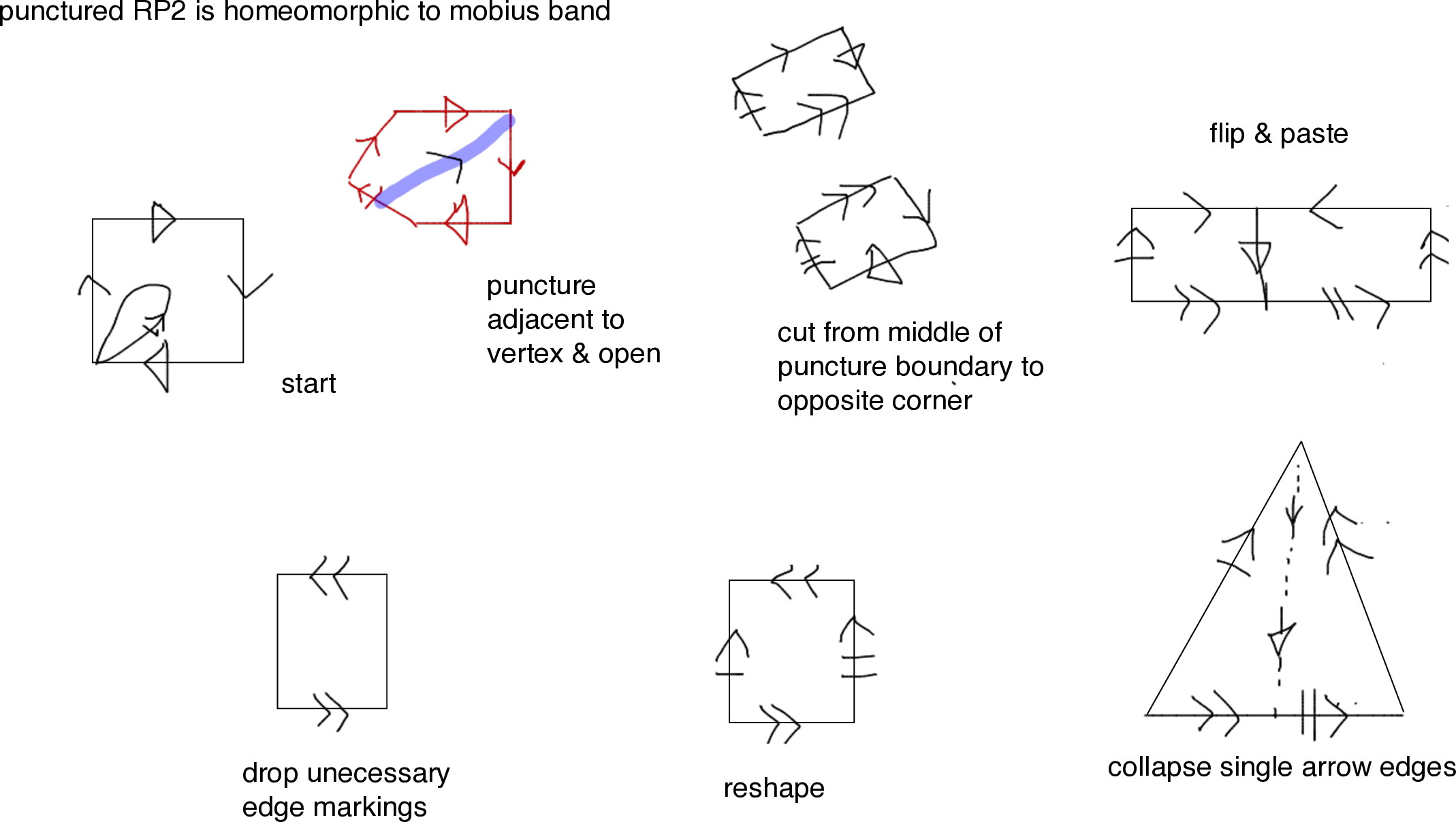
- Realize the Mobius band as a punctured projective plane.